Altermagnetism Emerges in BiFeO₃ Films Just 1.6 nm Thick
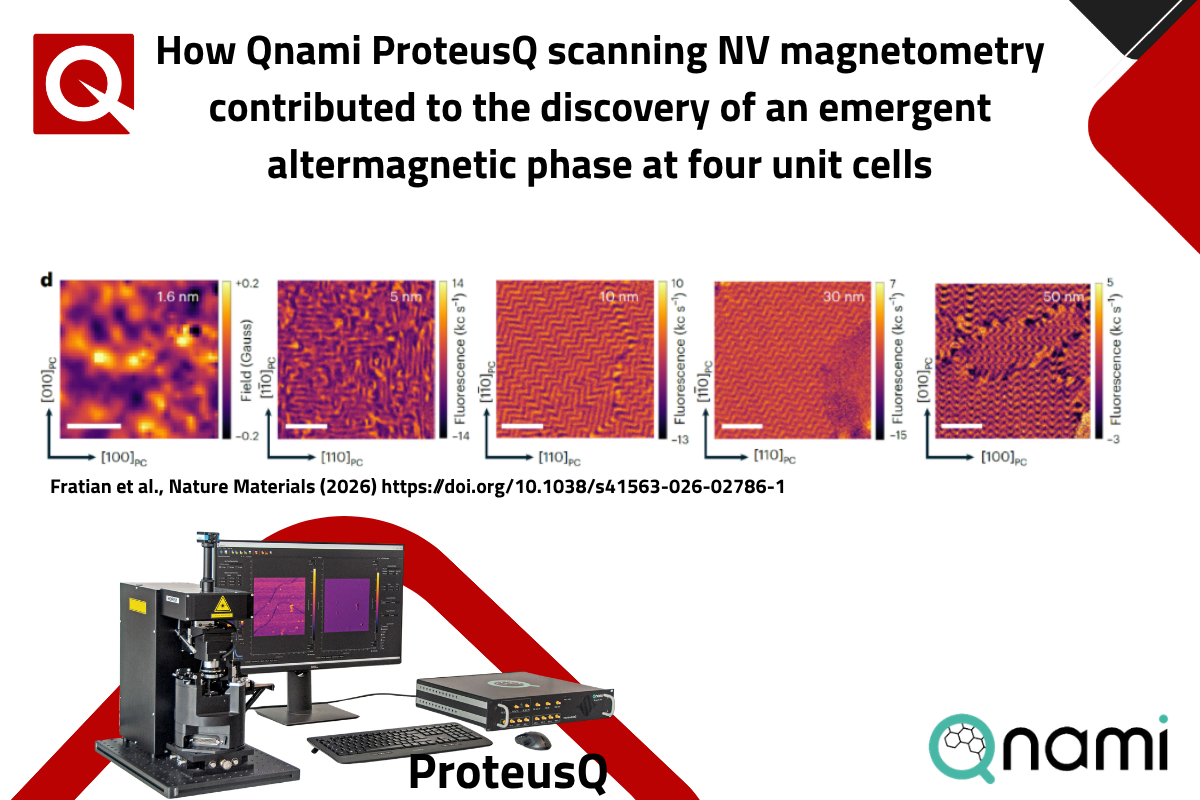
Multiferroic films usually lose their polar and magnetic order as they get thinner. A multi-institution team has now shown that this limit can be pushed back. In ultrathin BiFeO₃, they preserved both orders and, at four unit cells (approximately 1.6 nm), found a new structural and magnetic phase with signatures of altermagnetism. Scanning NV magnetometry on the ProteusQ provided the real-space magnetic maps that tracked this evolution.
Why it matters for low-power electronics
BiFeO₃ combines electrical polarisation and magnetic order, which makes it interesting for future voltage-controlled, low-power electronics. Practical devices, however, require ultrathin films, where depolarisation and magnetic dead layers typically degrade performance.
By engineering substrate-induced strain and electrical screening from a SrRuO₃ electrode, the team realised a multiferroic phase of BiFeO₃ with no dead layer. Key findings:
- Polar and magnetic order preserved in ultrathin films
- A continuous, thickness-induced phase transition, accompanied by coupled polar and magnetic topological textures
- At four unit cells, a collinear monoclinic phase with d-wave altermagnetic order, supported by magnetic circular dichroism and spin-resolved photoemission
These results point to a way of stabilising unconventional multiferroicity at device-relevant thicknesses, and they reframe the scaling limits for oxide electronics.
What ProteusQ contributed
Scanning NV supplied local, real-space maps of the weak magnetic stray fields as film thickness changed:
- 10–50 nm: characteristic zigzag spin-cycloid patterns
- 5 nm: the clear zigzag pattern disappears
- 1.6 nm: pulsed ODMR reveals magnetic contrast without the typical cycloidal signature
This helped establish that the magnetic texture reorganises as the film becomes thinner.

Scanning NV images of 10, 30 and 50 nm BiFeO₃ films. Dual iso-B fluorescence contrast; scale bars: 500 nm. Original colour scales retained. Cropped from Figure 2d, Fratian et al., Nature Materials (2026).
One discovery, many techniques
No single technique tells the whole story. X-ray measurements, atomic-resolution electron microscopy, spin-resolved photoemission and theory provided complementary evidence for the surviving order and the emerging phase. The detailed topological maps came from X-ray microscopy, and the altermagnetic interpretation rests on the combined evidence.
Additionally, ProteusQ can also be extended with standard SPM modules (AFM, LFM, EFM, MFM, KPFM, PFM, force curves and more), so scanning NV sits alongside your usual scanning probe measurements on the same platform.
Working on multiferroics, antiferromagnets, altermagnets or oxide spintronics? Visit the ProteusQ product page or contact our expert, Marwan Channab, to discuss how scanning NV can support your measurements.