
Real-Time Cellular Dynamics: Utilizing FlexAFM as a High-Sensitivity Nanomotion Sensor
Sensing living biological systems at the nanoscale reveals critical information about cellular mechanisms, responses to external stimuli, and metabolic cycles. Beyond migration and conformational changes, cells naturally vibrate, and atomic force microscopy (AFM) has proven to be an effective technique for detecting these movements. By pioneering this approach, known as the nanomotion sensor, Dr. Giovanni Longo has investigated human cells and bacteria at a fundamental level, working alongside his colleagues Simone Dinarelli and Marco Girasole at the CNR in Rome.
To execute these highly sensitive experiments, researchers used the Nanosurf FlexAFM. Dr. Longo confirmed that the FlexAFM offers exceptional stability and a compact footprint, allowing it to adapt effortlessly to diverse experimental conditions without the need for fluorescent labels or destructive sampling methods. Furthermore, its biological-focused design delivers the exact parameters required by researchers working with living systems, providing the versatile handling needed to perform specialized, living-cell manipulations.
How AFM Cantilevers Reveal vibrations and oscillations at the Nanoscale
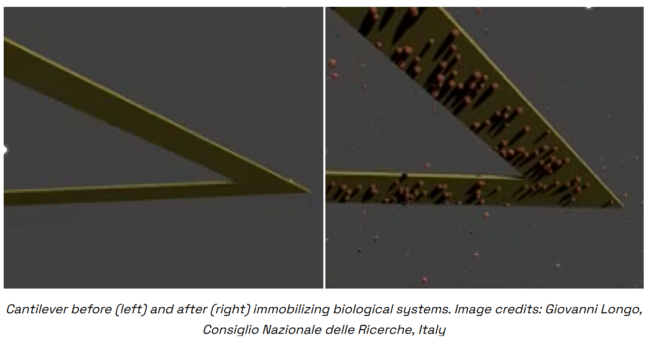
The innovation of the nanomotion sensor lies in exploiting the extreme mechanical sensitivity of the atomic force microscopy (AFM) cantilever to measure the nanometric vibrations and oscillations produced naturally by living cells and bacteria immobilized on its surface.
To prepare the sensor, the AFM cantilever is chemically functionalized with anchoring molecules such as fibronectin, glutaraldehyde, or poly-lysine. Once a drop of solution containing bacteria gets in contact with the cantilever, they settle on the surface and remain attached. For eukaryotic cells, researchers perform a process termed "fishing": cells are cultured in a Petri dish, brought into contact with the functionalized cantilever. At that point, cells prefer to attach to the cantilever rather than the substrate.
In a recent study on Staphylococcus aureus (a common bacterium that can cause infections ranging from mild skin conditions to severe diseases), Dr. Longo’s team synchronized the bacterial population through iron deprivation. Upon restoring the iron supply, the bacterial movements synchronized. This proves that cellular oscillations are tied tightly to metabolic variations.
Key advantages of the FlexAFM:
- Versatility: Its compact design allows it to be used flexibly across different experimental setups and situations.
- Biological Optimization: It works extremely well for demanding biological studies, providing the stability required for sensitive measurements.
- Reliable Experimental Freedom: Enables researchers to routinely perform any type of complex experiment on living cells with high satisfaction.
Core Applications: the utility of the FlexAFM
- Microbiology & Bacterial Behaviour: Investigating bacterial metabolic dynamics, mechanics, and immediate cellular movements in response to changing conditions.
- Antimicrobial Susceptibility Testing (AST): Monitoring the cessation or alteration of bacteria upon exposure to antibiotics, facilitating rapid efficacy profiling.
- Cellular Communication Research: Exploring how adjacent cells, such as neurons, interact through mechanical stimulation, demonstrating how individual vibrations propagate to and influence neighboring cells
Discover FlexAFM for your laboratory
Contact Stefano Pergolini