Advanced UV LED bonding for high-precision industrial assembly: beyond line-of-sight limitations
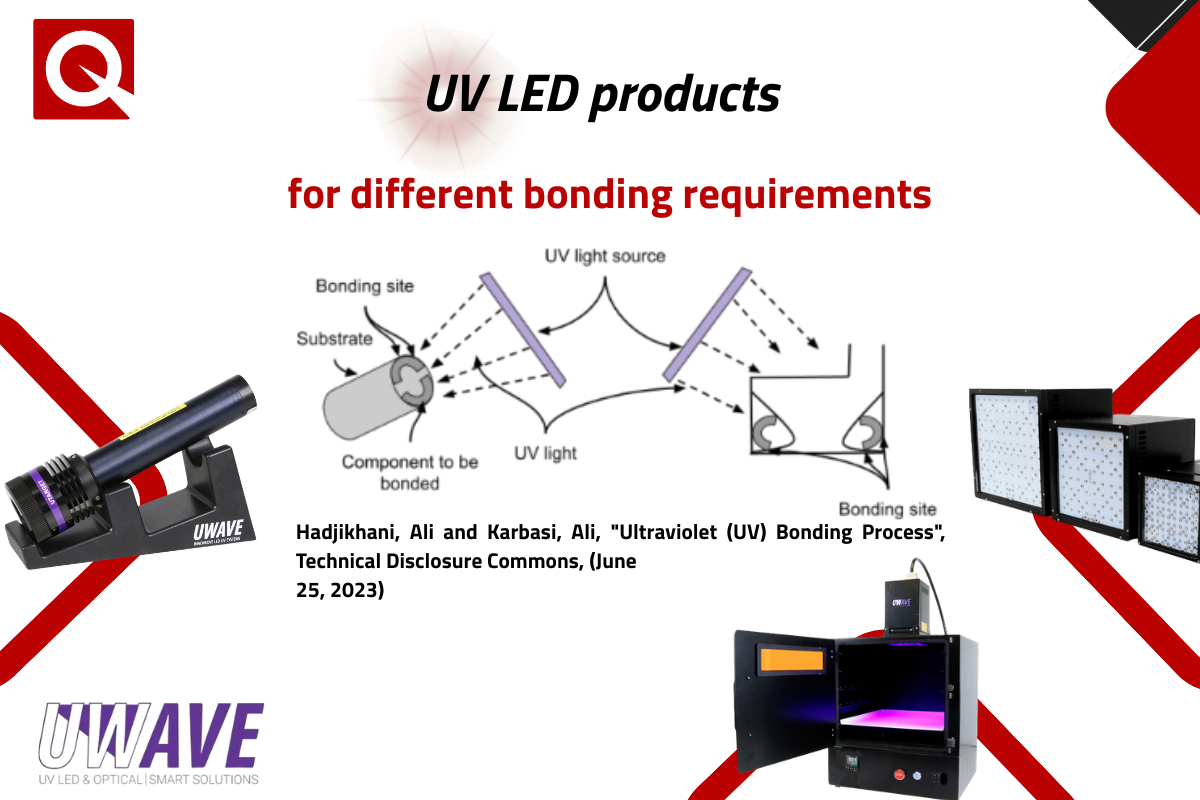
Modern industrial assembly increasingly demands high-strength bonding, rapid production cycles, and exceptional precision while minimizing thermal stress on sensitive components. Traditional thermal curing methods and mercury lamps often introduce longer processing times, higher energy consumption, and unwanted heat that may affect delicate materials.
UWAVE UV LED curing systems provide an efficient alternative by delivering high-intensity UV-A irradiation (365–405 nm, depending on the adhesive chemistry) for rapid photopolymerization. Their compact design, high electrical efficiency and precise light delivery make them an ideal solution for advanced manufacturing processes involving optical components, medical devices, electronics and high-value industrial assemblies.
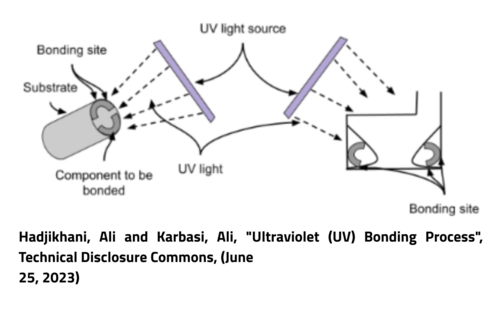
However, one important limitation remains: UV curing traditionally requires direct line of sight between the UV source and the bonding area. Complex geometries or intermediate materials may partially absorb UV radiation, leading to incomplete curing or making UV bonding impractical.
The science behind UV photopolymerization
UV bonding is based on a photochemical polymerization reaction.
Liquid UV adhesives contain a combination of:
- Monomers
- Oligomers
- Photoinitiators
When exposed to high-intensity UV-A light, the photoinitiators become activated and trigger the formation of a polymer network by linking monomers and oligomers together. The adhesive rapidly hardens, creating a strong and reliable bond between components within a very short curing time.
 UWAVE's UV LED technology delivers the controlled UV intensity required for these demanding industrial processes while replacing larger and more energy-intensive curing technologies.
Beyond conventional UV curing: X-ray activated photoluminescent bonding
Although UV curing is highly effective, its performance depends on the availability of a direct optical path between the UV source and the adhesive.
An emerging technique described in recent application studies overcomes this limitation by introducing photoluminescent materials into the UV-activated adhesive, photoresist or other bonding media.
The process follows a simple physical principle:
- Incident X-rays penetrate the assembled structure, even where direct UV illumination is impossible.
- The embedded photoluminescent material absorbs the X-ray radiation.
- The material subsequently emits UV radiation at the wavelength required by the adhesive chemistry.
- This locally generated UV light activates the photoinitiators, initiating polymerization directly at the bonding interface.
Since X-rays can penetrate a wide variety of materials without requiring direct line of sight, this approach enables UV-activated bonding in complex device architectures that were previously difficult or impossible to process using conventional UV illumination.
Depending on the implementation, the photoluminescent material can be:
- mixed directly into the UV adhesive before application;
- incorporated into photoresists;
- integrated into stamps;
- or applied directly onto bonding surfaces.
Applications
UWAVE UV LED solutions support high-performance bonding across multiple advanced manufacturing sectors:
| Industry | Typical Application |
|---|---|
| Optics & photonics | Optical bonding of glass, displays, lenses and transparent components while preserving optical properties of the materials |
| Medical devices manufacturing | UV adhesives enable the fast and precise assembly of plastic, metal, and transparent component. UWAVE solutions are well suited for the production of syringes, catheters, diagnostic devices and medical equipment requiring precision, reliability and cleanliness. |
| Loudspeaker and audio component assembly | Precise bonding of diaphragms, voice coils, magnets and acoustic components with excellent process repeatability maintaining consistent acoustic performance. |
| Industrial assembly applications | Fast and precise joining of various materials such as glass, plastics, metals and composites. The UWAVE technology provides instant polymerization, ensuring reliable, uniform, and long-lasting adhesion. |
| Luxury goods manufacturing and assembly | The rapid ultraviolet photopolymerization process delivers flawlessly clean, transparent, and aesthetically pristine finishes while protecting the structural integrity of delicate components. his method consistently satisfies the rigorous standards of quality, accuracy, and uniformity demanded in watchmaking, high jewelry, cosmetics, and premium accessories. |
Are you looking to eliminate thermal stress, overcome complex geometric restrictions, or scale up your batch-curing efficiency?
If you would like to learn more about UWAVE UV LED technologies, discuss your application, contact our expert Gianluca Zocchi or visit the UWAVE product page.
| +39 06 5004204 | |
| +39 06 5010389 | |
| gianluca.zocchiqd-europe.com |