
Recent advances in laser assisted electrodeposition
Electrodeposition is a well-established technique for the production of metallic and functional coatings. Its integration with a laser source makes it possible to introduce spatial control over the process by concentrating the energy input in selected regions of the surface.
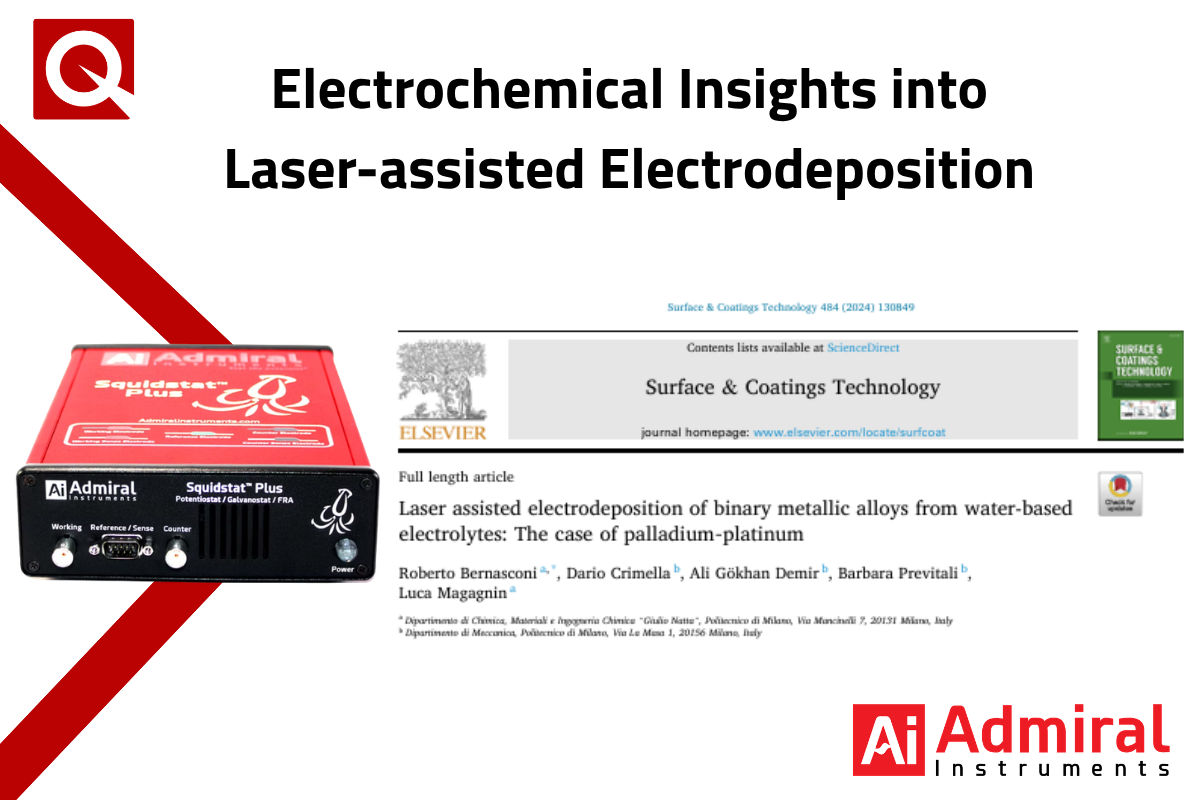
A particularly interesting example is the study published in 2024 by Roberto Bernasconi and co-workers in Surface & Coatings Technology, focusing on the laser-assisted electrodeposition (LAE) of palladium–platinum (PdPt) alloys from phosphate-based aqueous electrolytes. The work is of particular interest because, according to the authors, it represents the first demonstration of the deposition of a binary metallic alloy by LAE, extending a technique that had previously been applied mainly to pure metals.
From an instrumentation standpoint, the authors used an Admiral Squidstat potentiostat/galvanostat for the electrochemical characterization of the electrolytes and for the chronoamperometric experiments performed under laser irradiation.
From Conventional Electrodeposition to LAE
The study investigates the distinction between two types of laser electrodeposition (L. E.), referred to as:
- L. Enhanced E. (LEE)
- L. Assisted E. (LAE)
In LEE, the substrate is connected to an external power source, while the laser provides the additional energy required to promote deposition. In the LAE approach investigated by Bernasconi and co-workers in the cited study, no external polarization is applied during deposition.
According to the model discussed by the authors, the laser generates a local increase in temperature at the metal–solution interface, resulting in a shift in the open-circuit potential. This effect locally establishes the conditions required for the reduction of metal ions and the growth of the deposit. As a result of this mechanism, deposition occurs exclusively in the irradiated regions, enabling the fabrication of selective metallic patterns.
The PdPt System
To assess the potential of the technique, the authors selected the palladium–platinum (PdPt) system, investigating the effects of electrolyte composition and laser parameters on alloy growth.
The objective was to correlate the electrochemical properties of the solutions with the composition, morphology, and thickness of the resulting deposits. The results demonstrate the possibility of obtaining continuous coatings with controlled composition, as well as localized structures with complex geometries.
The Role of Electrochemical Characterization
A central part of the study concerns the characterization of the electrolytes by cyclic voltammetry (CV) and chronoamperometry (CA).
The electrochemical data reveal marked differences between palladium and platinum. In particular, Pd reduction exhibits a limiting current density significantly higher than that observed for Pt.
The authors relate this behavior to the greater contribution of Pd to mass-transfer and deposition processes. An interesting relationship thus emerges between electrolyte composition, electrochemical response, and the composition and growth rate of the deposit.
The Laser as a Tool for Localized Process Control
In addition to the local shift in the open-circuit potential, laser irradiation produces steep thermal gradients that promote mass transport and increase the rate of electrochemical reactions.
The experimental evidence shows that increasing the laser power generally increases the amount of deposited material, whereas higher scanning speeds reduce the interaction time and, consequently, the coating thickness.
With regard to alloy composition, the dominant factor remains the electrolyte formulation. Laser parameters exert a secondary influence, with a slight tendency toward increased palladium content at higher powers and lower scanning speeds. This result supports the hypothesis that the process is predominantly mass-transfer controlled.
From Characterization to Material Properties
The study is not limited to electrochemical analysis. The PdPt deposits were characterized by SEM, EDS, AFM, XRF, and XRD to evaluate their morphology, composition, surface roughness, thickness, crystal structure, and mechanical properties.
A particularly interesting result was obtained by X-ray diffraction: the PdPt alloys form a substitutional solid solution across the entire compositional range investigated. In addition, the deposits exhibit a fine microstructure consistent with the high growth rates characteristic of LAE.
Hardness measurements revealed a less intuitive behavior: the alloys exhibited lower hardness values than the pure metals, suggesting that solid-solution strengthening is limited in this system.
Admiral Squidstat in the Research Workflow
The PdPt case study provides a concrete example of how a potentiostat/galvanostat can support the development of novel laser-assisted deposition processes.
The Admiral Squidstat was used by the authors to acquire cyclic voltammetry and chronoamperometry data, making it possible to correlate electrolyte behavior with the characteristics of the resulting coatings.
In a laboratory dedicated to the development of functional materials, instruments of this type can be used to compare electrolyte formulations, investigate the effects of process parameters, and understand the mechanisms governing deposit growth.
Conclusions
The study published in Surface & Coatings Technology demonstrates the feasibility of using laser-assisted electrodeposition to produce PdPt alloys without external polarization from phosphate-based aqueous electrolytes. The work also represents one of the first demonstrations of LAE deposition of a binary metallic alloy.
The results highlight how electrolyte composition, the electrochemical behavior of the metal species, and laser parameters collectively determine the final characteristics of the coating. The characterization performed using the Admiral Squidstat forms part of an integrated approach in which electrochemistry and materials characterization contribute complementarily to understanding the deposition process and optimizing the properties of the resulting alloys.
Discover the Admiral Squidstat and its technical capabilities on the dedicated product page.
Contact Dario D’Ubaldo, our product expert, to discuss your application and discover how the Admiral Squidstat potentiostat/galvanostat can support your research needs.
| +39 06 5004204 | |
| +39 06 5010389 | |
| dario.dubaldoqd-europe.com |