

Cryogenic, compact, scalable: The future of microresonators

Fig. 1: The Qlibri microresonator combines a fiber mirror with a planar substrate mirror and is integrated into Montana Instruments' Cryostation S200 – for stable quantum optical experiments at 4 K.
Optical platforms for micro-resonators enable the targeted coupling of light to individual quantum systems such as NV (Nitrogen vacancy) centers, quantum dots, or organic molecules. This is a crucial step for applications in quantum communication, sensor technology, and materials research. Until now, the use of such platforms in closed-cycle cryostats has been severely limited due to mechanical vibrations – even though these cryostats are much easier to handle due to the elimination of liquid helium. Qlibri has solved this problem: through the development of rigid micropositioners, active control mechanisms, and passive vibration isolation, the resonator length now remains stable in the picometer range. In combination with Montana Instruments' Cryostation S200, which reaches temperatures as low as 4 K and offers a low-vibration usable volume, high-precision quantum optical experiments under cryogenic conditions are now automated, reliable, and scalable.
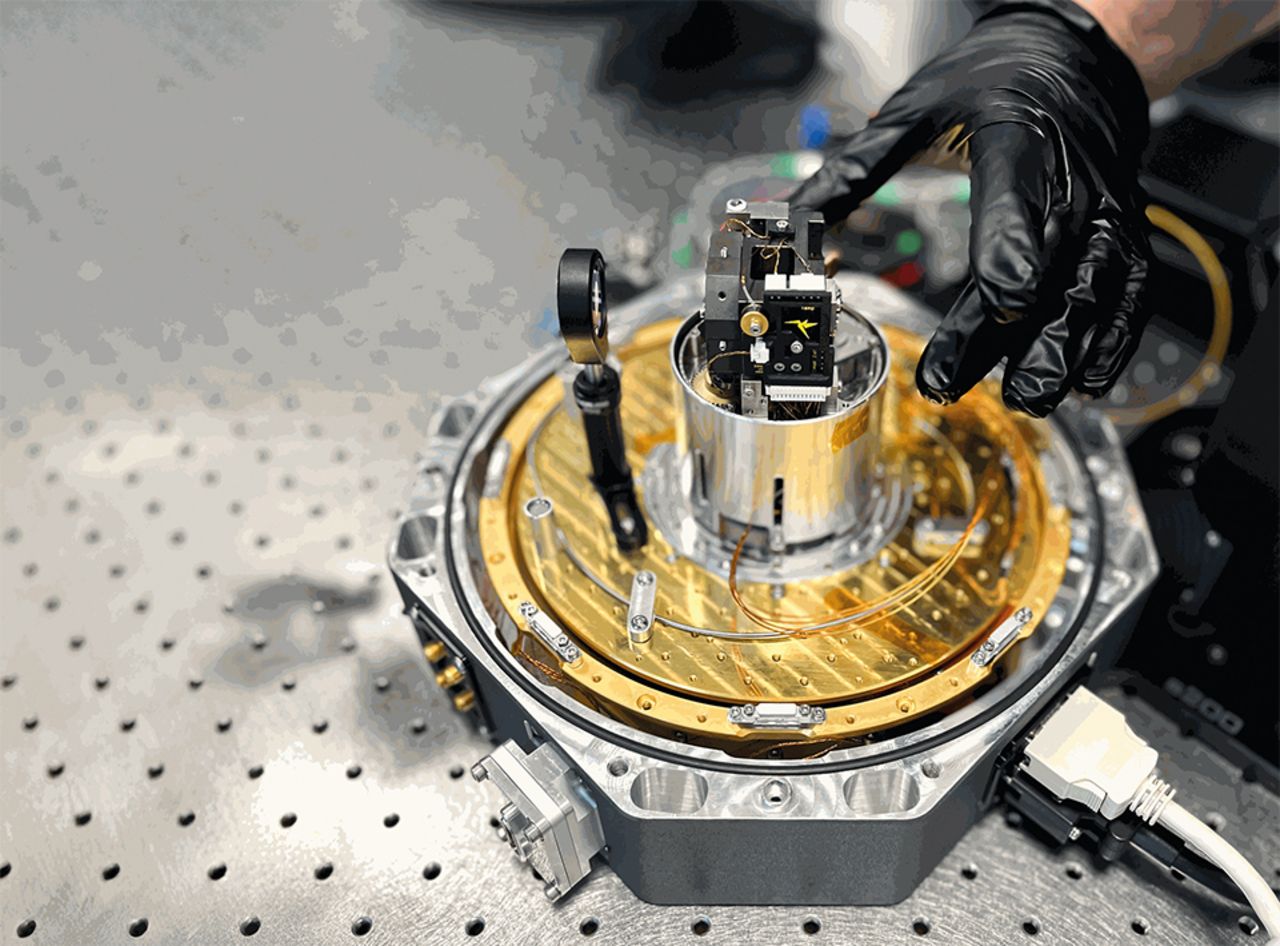
Fig. 2: Qlibri optical resonator platform mounted on the cooling platform of a Montana Instruments Cryostation S200
The platform offers a generous usable volume with minimal vibrations of less than 15 nm in all spatial directions – ideal for sensitive coupling processes between light and matter. The resonator length is stabilized using a PID (proportional-integral-derivative) controller that monitors the position of the resonance edge in the transmission signal. This allows the resonance to be controlled with extreme precision – with finesse values above 10⁵ and quality factors above 10⁶. Thanks to automated control and an API interface, repeatable measurements are possible at 10- to 30-minute intervals. The platform not only allows individual quantum systems to be addressed specifically, but also enables them to be operated in parallel – a decisive step towards scalable quantum technologies. The integration of an optional magnet module further expands the range of applications, for example through precisely controllable magnetic fields up to 500 mT for the investigation of magnetically sensitive transitions.
The ability to generate stable magnetic fields without additional heat load allows for the targeted control of optical transitions and the investigation of new coupling regimes between light and matter. This makes the platform increasingly relevant for both basic research and application-oriented developments in quantum optics and quantum sensing. The Qlibri microcavity platform not only opens up new possibilities for precise single-photon experiments under cryogenic conditions, but also lays the foundation for scalable quantum technologies. The miniaturization of the components will allow multiple independent quantum systems to be operated in parallel in a cryostat in the future, which could be a decisive step toward complex quantum architectures.