

Quantum Sensing for MRAM: Gaining insights into the nanoscale with the "ProteusQ" scanning NV magnetometer
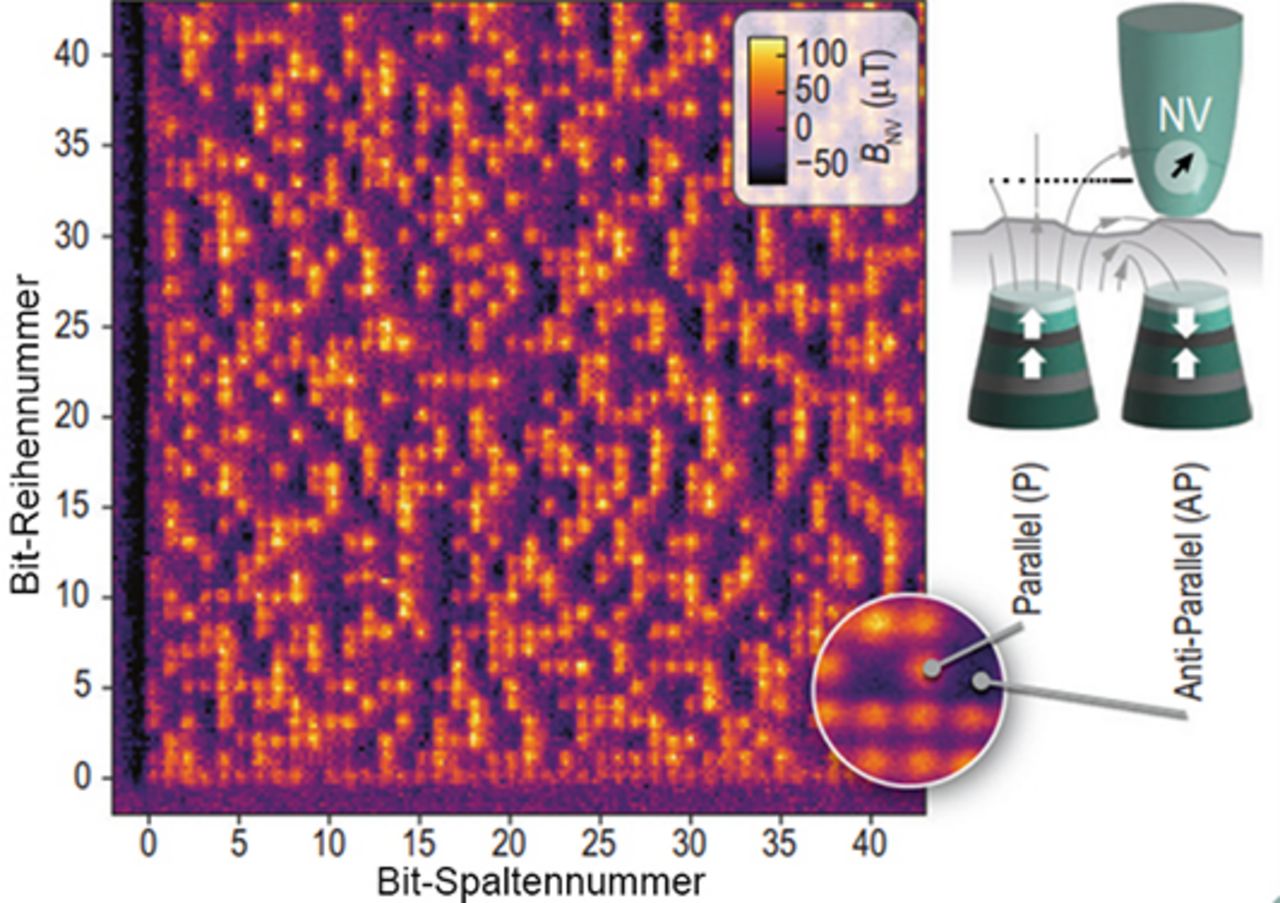
Fig. 1: Left: SNVM map of a 45 × 45 bit area (10 × 10 μm) after encapsulation. Bits in the antiparallel (AP) state appear dark, while bits in the parallel (P) state are shown in light.
Right: The P and AP configurations of the bits generate different stray field patterns (gray lines). The NV probe measures the projection of these fields along its quantization axis (black arrow) at a defined distance from the sample (“flying distance”). Graphic taken from: [1]
Innovative storage technologies such as MRAM (magnetoresistive random-access memory) could replace classic non-volatile storage such as eFlash in the future. Precise characterization of individual memory cells is crucial to driving this development forward in a targeted manner. With the help of highly sensitive quantum sensor technology, in particular through the use of scanning nitrogen vacancy magnetometry (SNVM), magnetic properties such as hysteresis behavior, thermal stability, and switching statistics of individual bits with a diameter of <60 nm can be spatially resolved. The performance of this method was recently demonstrated in a publication by Borràs et al., in which individual MRAM bits were successfully characterized and process-related deviations were identified [1].
Nitrogen vacancy (NV) centers in diamond act as atom-sized magnetic field sensors whose quantum states are influenced by local magnetic fields.
Unlike conventional ensemble measurement methods, SNVM enables the identification of so-called "tail bits," bits with deviating magnetic properties that often occur at the edges of arrays and represent potential sources of error. This single-bit analysis allows for a reliable assessment of bit-to-bit uniformity and provides valuable insights into memory and switching behavior.
The method opens up new possibilities for quality control and error analysis directly after the etching process in semiconductor manufacturing. Thanks to its high spatial resolution and ability to quantify magnetic parameters at the single-bit level, SNVM can be used as a powerful tool for process development and monitoring. In the future, the measurement speed can be significantly increased, making integration into industrial production lines a realistic prospect.
These advances in nanoscale quantum technology mark an important step toward the reliable and scalable characterization of future memory architectures.
ProteusQ and its role
Qnami's ProteusQ system is based on SNVM and enables non-contact, nanoscale magnetic field measurements. In collaboration with imec, Qnami was able to demonstrate that encapsulated spin transfer torque MRAM bits (STT-MRAM) can be characterized early in the process line without any electrical connection.
System properties
- Analysis of magnetic switching processes at the bit level: ProteusQ can resolve the magnetic switching behavior of individual bits (<60 nm) and provides information on thermal stability and switching statistics.
- Fault analysis: The system detects so-called "tail bits" outside the normal distribution, which are often located at the edges of arrays and are not visible with ensemble techniques such as the magneto-optical Kerr effect (MOKE)
- Correlation with magnetic roughness: With the help of ProteusQ, Qnami was able to establish a correlation between switching behavior and magnetic roughness
[1]: V. J. Borràs et al., A quantum sensing metrology for magnetic memories, Nature Spintronics (2024), https://doi.org/10.1038/s44306-024-00016-5