Alloy Anodes Reduce Interphase Growth in Solid-State Batteries: Insights from CTTA
Understanding interphase growth with CTTA
Interphase formation between solid electrolytes and negative electrode materials can increase cell resistance and contribute to solid-state battery degradation. Understanding how these layers develop is therefore an important step in evaluating materials for next-generation batteries.
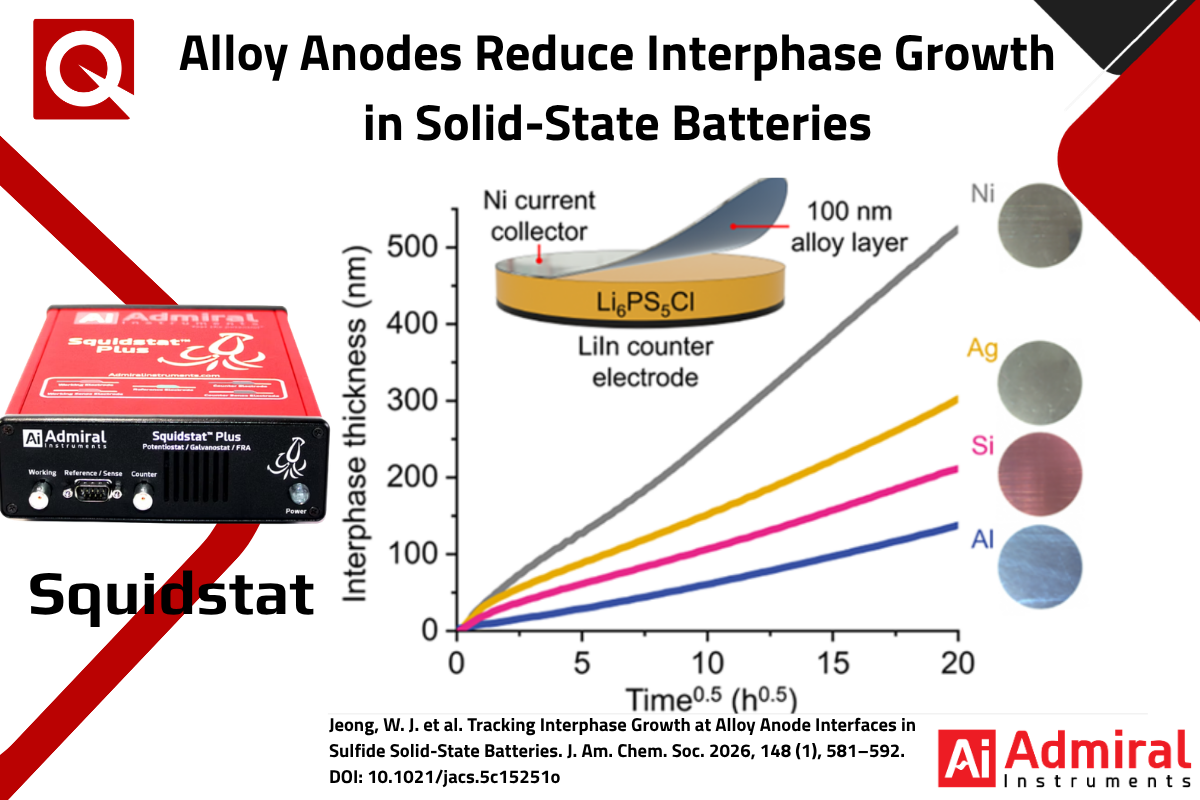
Researchers at the Georgia Institute of Technology investigated four alloy anodes — silver (Ag), aluminium (Al), silicon (Si) and germanium (Ge) — in contact with the sulphide solid electrolyte Li₆PS₅Cl, comparing their behaviour with that of pure lithium metal.
The team used Coulometric Titration Time Analysis (CTTA) to track interphase growth over 400 hours. By monitoring the electrochemical capacity consumed during successive titration and resting periods, the technique enables researchers to quantify interphase development over time.
What the research reveals
The study identified several important differences between pure lithium and alloy anodes:
- Reduced interphase thickness: After 400 hours, all four alloy anodes exhibited less than half the interphase thickness measured for pure lithium metal under the high stack pressures investigated.
- Promising results for aluminium: Among the alloy materials studied, aluminium showed the lowest interphase growth rates.
- The influence of pressure and contact: Interphase growth depended not only on the electrochemical properties of the anode, but also on stack pressure and the contact area between the electrode and solid electrolyte.
These findings highlight the potential of alloy anodes to improve interfacial stability in solid-state batteries, while underlining the need for further research to reduce interphase growth and interfacial resistance.
CTTA Measurements with Squidstat Potentiostats
Coulometric Titration Time Analysis requires precise electrochemical measurements over repeated titration and resting periods to track the capacity consumed during interphase formation. In this study, researchers at the Georgia Institute of Technology used a Squidstat potentiostat from Admiral Instruments to perform CTTA measurements over 400 hours, investigating the behaviour of four alloy anodes in contact with the Li₆PS₅Cl solid electrolyte.
During each titration step, a controlled amount of charge was applied to the cell. The researchers then monitored the electrode potential during open-circuit resting periods, using the electrochemical response to follow interphase development over time. Repeating this sequence enabled them to compare interphase growth across different anode materials and stack pressures.
By supporting these measurements throughout the extended experimental programme, Squidstat provided the electrochemical data used to quantify and compare interphase growth kinetics. The results demonstrate how potentiostatic instrumentation can support detailed investigations of electrode–electrolyte stability in solid-state battery research.
Contact Dario D’Ubaldo for further technical information, or visit the Squidstat potentiostat product page