

Woollam Newsletter – Issue 24 has been published
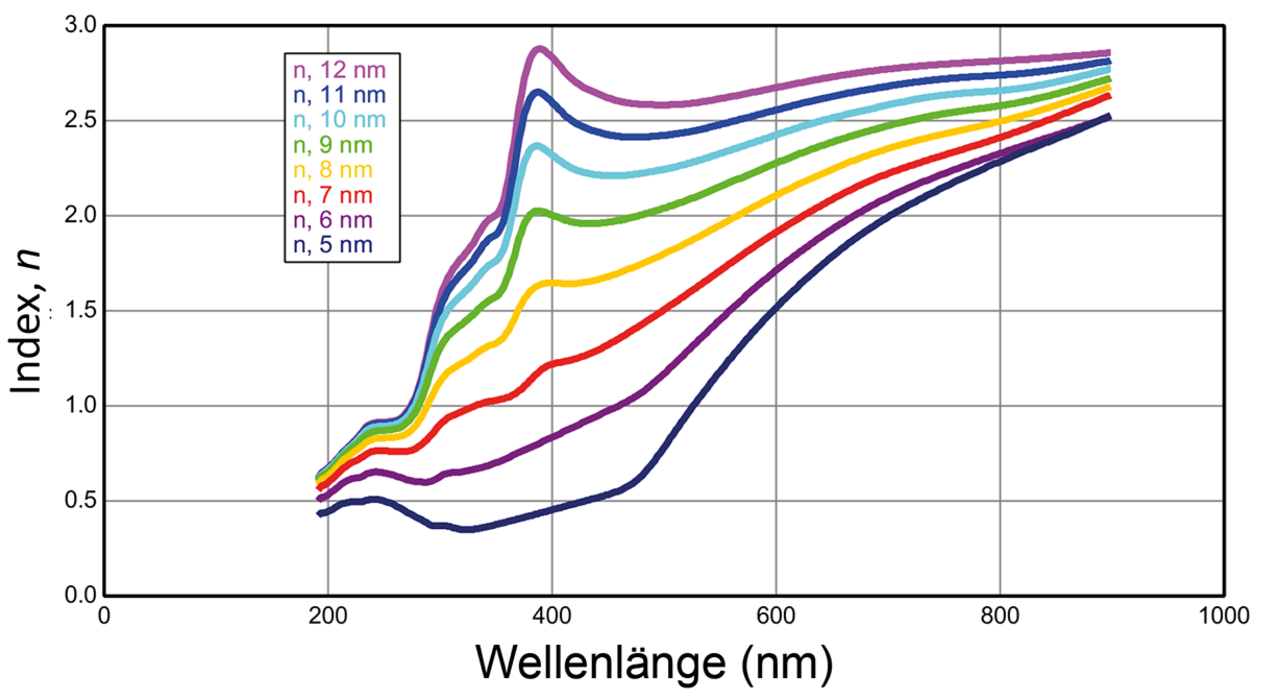
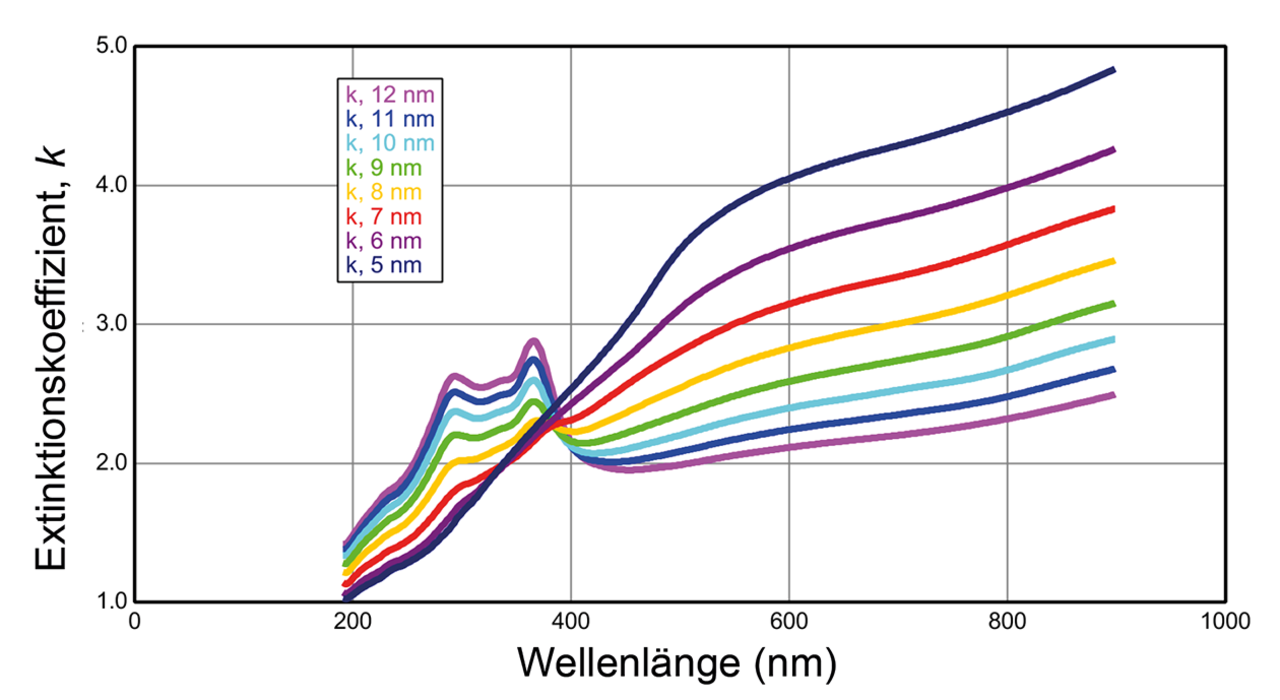
n(λ) (top) and k(λ) (bottom) for a metal film on a silicon substrate, where the thickness of the metal film was recorded at different values
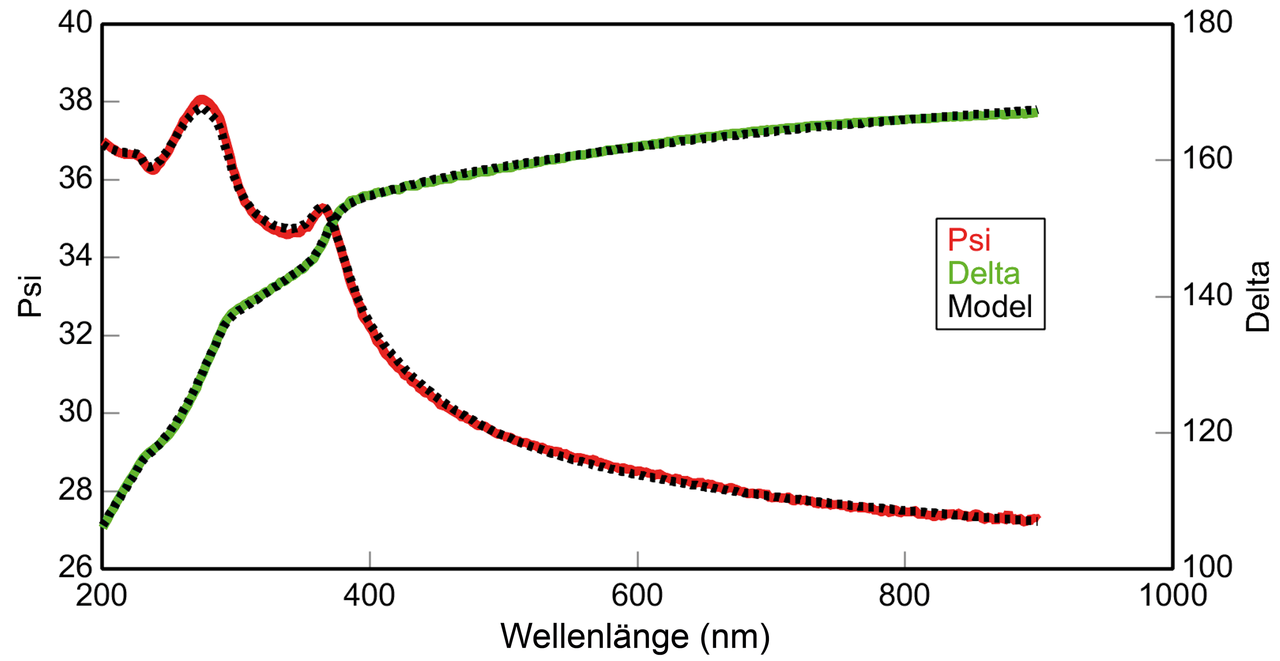
Ψ- and ∆-spectra (SE raw data) of a silicon wafer coated with a thin metal layer
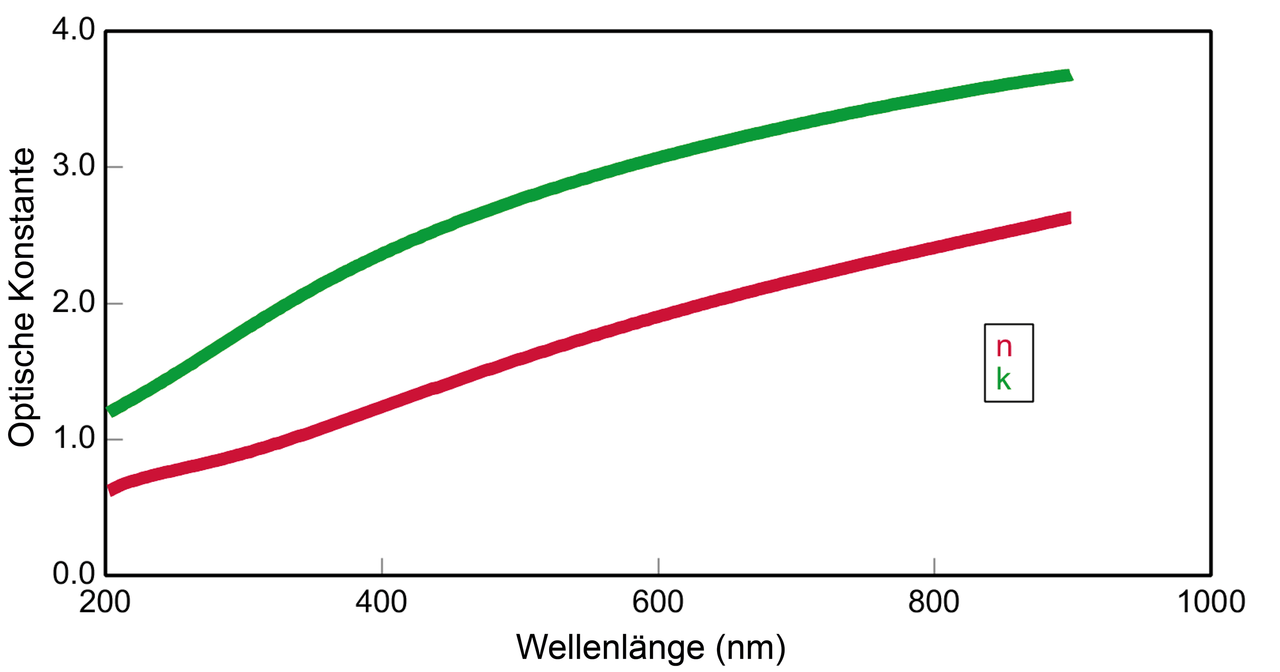
The optical constants for the metal film in the model
The new Woollam newsletter is here. In issue 24 you will once again find interesting articles on the subject of spectroscopic ellipsometry and all about Woollam. One article describes "Optical Critical Dimension Metrology" with spectroscopic ellipsometry (SE).
Further topics:
- 30 years with J.A. Woollam Japan
- Portrait: Prof. Rüdiger Goldhahn, University of Magdeburg
- New, extended functions of the Gen-Osc model in CompleteEASE
- New development in infrared ellipsometry through the use of quantum cascade lasers - higher intensity, significantly faster measuring time and options for smaller measuring spots
- Outlook for the next ICSE-10 in Boulder, Co. from June 8-13, 2025
- We would particularly like to draw your attention to the article "Minimizing artefacts when modelling ellipsometric measurement data".
Introduction
SE is primarily used in the semiconductor industry. While SE data can usually be collected quickly, analyzing data from unknown, complex materials can be difficult and challenging.
SE can only provide limited information about a sample. An SE measurement determines two unique pieces of information at each wavelength, which can be represented as Psi (Ψ) and Delta (∆). If it is a thin film that absorbs light at all wavelengths (most metal films fall into this category), both its optical constants at each wavelength (n and k or ε1 and ε2) and its thickness must be determined. The problem is therefore underdetermined.
Minimization of artefacts
One solution is known as "artefact minimization". In 1984, Hans Arwin and David Aspnes proposed an approach to uniquely determine the thickness and optical constants of very thin films. The strategy works if the Ψ- and ∆-SE data have sharp spectral features that are not present in the optical constants of a thin film. Different layer thicknesses are considered/modeled to determine the corresponding thin film optical constants that best match the data.
If the optical constants of the thin film have the same (often sharp) spectral structures as the raw data, the thickness is probably incorrect. Incorrect thicknesses force the model to translate these structures into the optical constants of the layer. In describing this strategy, Hans Arwin recently remarked (and we quote): "It's like trying to cut the top layer of frosting off a cake with a knife. If you cut too low, you get part of the cake; if you cut too high, you get frosting, i.e. negative frosting on the knife. So with this approach we can decouple the thickness of a thin film from its optical constants, which is often difficult to achieve with other methods."
The minimization of artefacts can be applied to any absorbing layer, but especially to thin metal layers.
Further information on this topic and a detailed description of the "Interference Enhancement" method can be found in the corresponding article in the new newsletter.