
New Prospects for Lithium-Ion Batteries: The Role of Admiral Instruments' Squidstat Plus Potentiostat in University of Toronto Research
The rapid development of energy storage technologies and the global transition toward renewable energy demand increasingly efficient and safe lithium-ion batteries (LIBs), particularly for electric vehicles and portable electronics. However, the performance of these batteries is limited under harsh conditions, such as low temperatures and fast-charging processes, which cause slow lithium-ion diffusion and instability of the solid electrolyte interphase (SEI) layer on the graphite anode.
To overcome these barriers, researchers at the University of Toronto have developed an innovative two-step controlled chemical approach (acid etching with HNO3/H2O2 followed by alkaline leaching with NH4OH) on natural graphite. This treatment yielded an etched expanded graphite (EG) featuring nanoscale holes, increased interplanar spacing, and optimized porosity, ideal features for shortening ion diffusion pathways without damaging the material's crystalline structure.
The Fundamental Contribution of Admiral Instruments' Squidstat Plus
To demonstrate the effectiveness of this microstructural modification and to understand the kinetic mechanisms of the new material, the research group relied on the Squidstat Plus Potentiostat from Admiral Instruments. The instrument served as the key ally for performing the most critical electrochemical tests: cyclic voltammetry (CV) and electrochemical impedance spectroscopy (EIS) on half-cells, monitoring anode behavior for up to 20 cycles and providing the necessary data to map the evolution of interfacial resistances.
Thanks to the precision and sensitivity of the Squidstat Plus, researchers were able to accurately quantify the kinetic advantages of etched expanded graphite (EG) compared to pure graphite (PG):
- Charge Transfer Resistance (Rct) Analysis: Nyquist plots obtained via EIS showed that, after cycling, pure graphite (PG) undergoes a drastic increase in Rct, signaling a severe kinetic degradation at the electrode-electrolyte interface. In contrast, etched expanded graphite (EG) registered an extremely contained resistance increase, confirming that its porous and expanded structure facilitates electrochemical reactions, ensuring lower resistance and efficient ion transport throughout the electrode.
- Solid Electrolyte Interphase Study (Rsei): The instrument revealed that both the solution resistance (Rs) and the solid electrolyte interphase resistance (Rsei) remain consistently lower and more stable in the EG anode, indicating optimal electrolyte penetration and significantly reduced parasite electrolyte decomposition compared to PG.
- Lithium Diffusion Coefficient Calculation (DLi): Thanks to the EIS data and the Warburg factor obtained directly from the Squidstat Plus measurements, the researchers calculated the diffusion coefficient. The EG anode demonstrated an extraordinarily superior ionic mobility while maintaining clear resistance to post-cycle degradation, yielding a value of 4,19 x 10⁻¹³ cm2 s-1 compared to PG, which stops at a value of 9,60 x 10⁻¹⁴ cm2 s-1.
- Cyclic Voltammetry (CV): CV measurements conducted with the Squidstat Plus highlighted well-defined cathodic and anodic peaks and a more pronounced current intensity for the EG, synonymous with greater lithium storage capacity and excellent reversibility. The narrower peak separation compared to PG further confirmed a drastic reduction in polarization and energy losses.
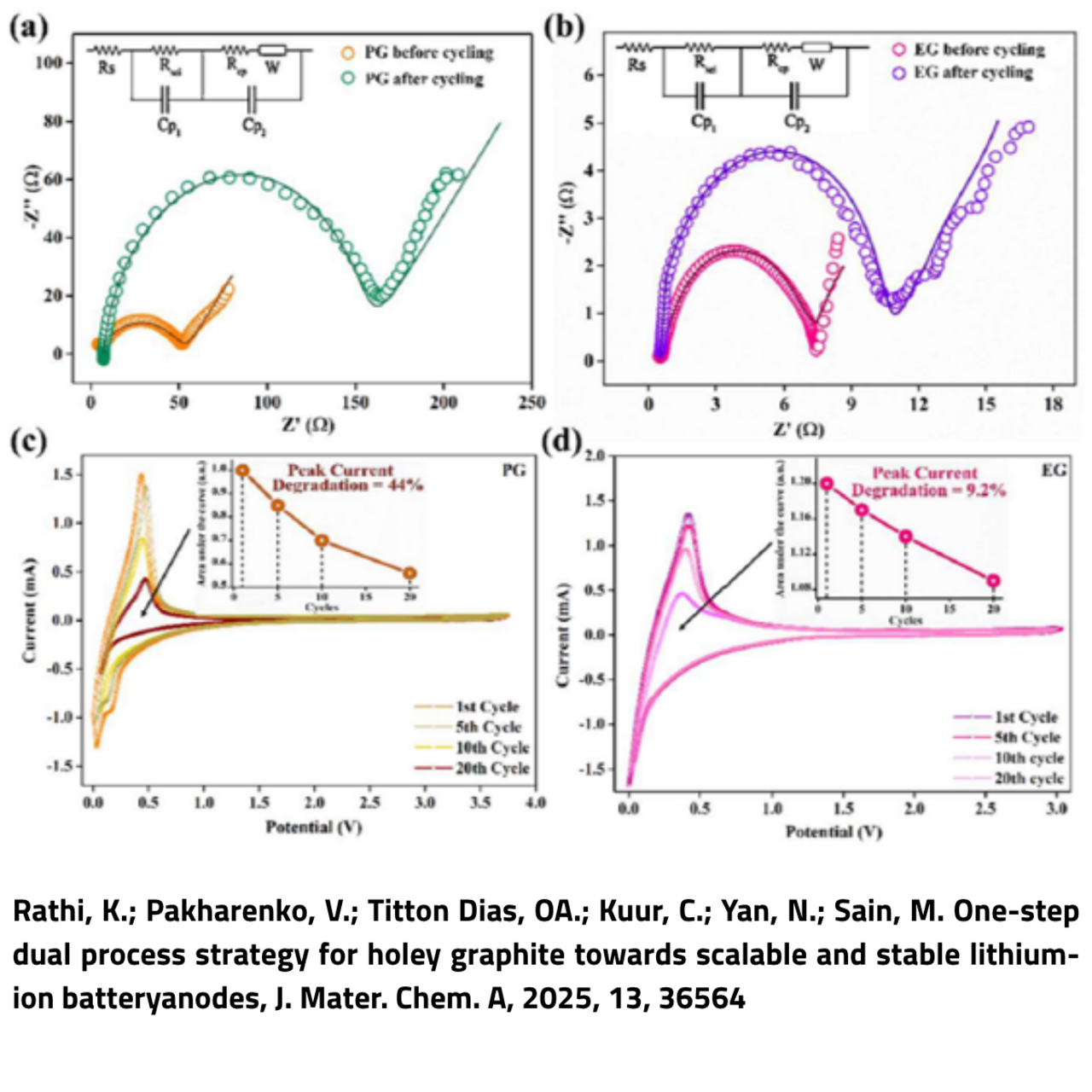
Figure 1. (a and b) Electrochemical Impedance Spectroscopy (EIS) analysis of PG and EG cells; (c and d) cyclic voltammetry (CV) profiles of PG and EG before and after cycling.
Post-Mortem Results and Long-Term Performance
The electrochemical data provided by Admiral Instruments' Squidstat Plus found a perfect correlation with the subsequent physical and chemical analyses conducted on the cells after 300 stress cycles. This link demonstrates how initial measurements taken with the Admiral instrument are crucial for predicting the actual durability and stability of materials over time.
Would you like to learn more about this instrument or see it in action in your laboratory? Looking to expand your measurement portfolio for EIS?
Contact Dario D'Ubaldo for a technical discussion or click here!