Supercontinuum Fiber Laser Iceblink and Tunable Accessory Boreal for the Optical Characterization of Thin Membrane-based Perovskite Structures
Mid-infrared (MIR) applications are playing an increasingly important role in fields such as gas sensing, bioimaging, and environmental monitoring. However, developing detector systems capable of operating with high sensitivity at room temperature still represents one of the main challenges in advanced optoelectronics due to the low energy of photons. In fact, the detectors currently on the market that operate at room temperature have a reduced detection bandwidth.
In this context, a recent study by the Guo research group at Yale University has highlighted the potential of two-dimensional metal halide perovskites (2D-MHPs) as an innovative platform for high-performance MIR detection. Thanks to their unique optoelectronic properties, including high optical absorption, strong excitonic response, and extremely low thermal conductivity, these structures make it possible to achieve very high sensitivity levels without resorting to complex and expensive cryogenic systems.
To precisely characterize the optical behavior of these innovative materials, the Yale team chose FYLA technology, utilizing the Iceblink Supercontinuum Fiber Laser together with the Boreal tunable filter.
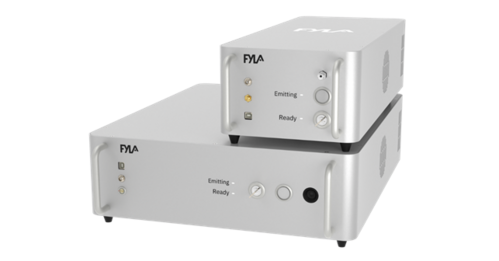
The Iceblink + Boreal combination enabled optical measurements for the characterization of of thin Membrane-based Perovskite Structures, which are essential for analyzing, with high precision, the reflectance variations induced by MIR radiation on the surfaces. The Iceblink source is capable of emitting ultrashort pulses with a duration of less than 10 ps across a spectral range of 450 to 2300 nm, while the Boreal filter allows for the selection of the visible part of the spectrum with a bandwidth ranging from 10 nm to 300 nm.
The power stability of the Iceblink broadband source, with a standard deviation of less than 0.5%, played a decisive role in achieving highly reliable and reproducible experimental results. Thanks to this configuration, researchers were able to study 2D-MHPs films with dielectric coatings, achieving sensitivities lower than 100 pW μm⁻² (Figure 1) and lower than 10 pW μm⁻² (Figure 2). 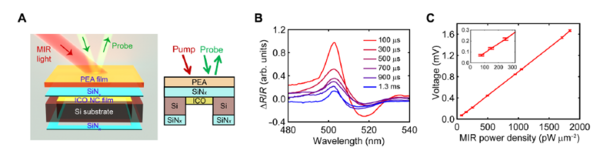
Figure 1. Thin membrane-based structure with < 100 pW μm−2 sensitivity. A) Drawing of PEA/SiNx/ICO-1membrane structure supported by a Si substrate. B) Transient ΔR∕R spectra of a floating PEA membrane for varying delay times. C) Lock-in voltage of PEA/SiNx/ICO-1on Si versus MIR (3.33 μm.)
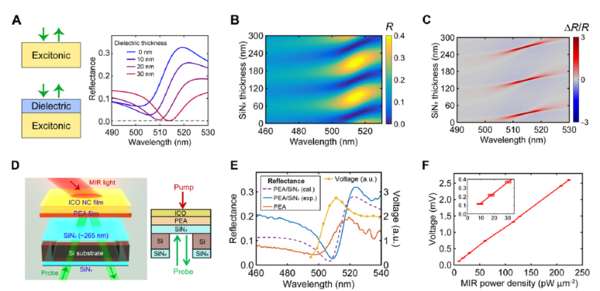
Figure 2.Thin membrane-based structure with a dielectric coating can achieve sensitivity of less than 10 pW/μm². A) The dielectric coating decreases reflectance near the excitonic resonance of PEA. B) Reflectance spectra were calculated for PEA films covered with SiNx, with thicknesses ranging from 0 to 300 nm. C) A color-coded map shows reflectance changes based on wavelength and SiNx thickness. D) A scheme illustrates the structure and measurement scheme. E) Reflectance spectra for PEA with and without SiNx coverage were compared, showing significant differences. F) Finally, the lock-in voltage of the structure versus MIR power density was measured, demonstrating the system’s sensitivity.
For those working in advanced optical characterization, the quality of the light source is a crucial element. Power fluctuations, complex alignments, and continuous calibrations can compromise data quality and slow down experimental work. It is precisely in this scenario that Iceblink makes the difference: a robust, stable, and immediately ready-to-use white light source, designed to ensure reliable measurements over time and simplify daily laboratory work.
With Iceblink and the Boreal filter, complex multi-laser configurations can be replaced by a compact and versatile platform, improving measurement accuracy, reproducibility, and speed. The result is a simpler and more efficient workflow, allowing researchers to truly focus on what matters most: developing new ideas, validating new devices, and accelerating innovation.
As demonstrated by the Yale University group, the combination of the FYLA Supercontinuum laser and tunable filter represents today an ideal solution for advanced applications in photonics, 2D materials, MIR detectors, optoelectronics, and high-precision spectroscopy.
Contact us to discover how Iceblink and Boreal can enhance your laboratory's performance and take your optical characterization to the next level!
For info on the Iceblink Laser click here>>