Webinar: the biology behind antibody-drug conjugates
How can you tell whether an antibody-drug conjugate (ADC) binds its intended target—and how can you distinguish target-dependent binding from nonspecific interactions?
Surface Plasmon Resonance Microscopy (SPRM) helps answer these questions by measuring binding interactions directly at the cell surface. Rather than relying solely on an averaged response across the sensing area, SPRM analyzes hundreds of spatially defined regions of interest (ROIs), revealing differences in binding behavior across the cell population.
By characterizing association and dissociation kinetics and deriving affinity measures, SPRM provides a detailed view of ADC–target interactions. When combined with appropriate controls, it can also help researchers assess whether observed binding is target-dependent.
But binding is only the first step. To understand an ADC’s mechanism of action, researchers need to investigate what happens next: does the target–ADC complex internalize? Does the cytotoxic payload drive target-cell killing? And can the immune system contribute to cytotoxicity?
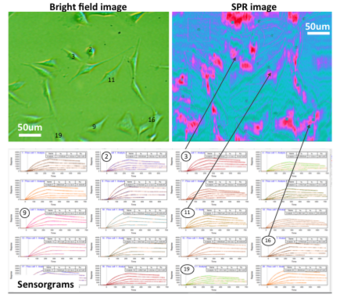
Figure 1. A side-by-side comparison of a bright-field image (left), an SPR image (right), and corresponding sensograms (below), obtained from different areas of the sample.
In this upcoming webinar, we’ll explore an integrated approach that combines SPRM with PathHunter® internalization assays and KILR® cytotoxicity assays to connect cell-surface binding with downstream functional readouts. We’ll also discuss how complementary effector-function assays can help assess Fc-mediated mechanisms, including antibody-dependent cellular cytotoxicity (ADCC) and antibody-dependent cellular phagocytosis (ADCP).
Join us to discover how complementary assays can build a more complete picture of ADC activity and support candidate evaluation during preclinical development.
The workflow, step by step
- Does the ADC bind its target? SPR microscopy (SPRM) measures binding affinity and kinetics directly on the surface of living cells. The sensing area is divided into about 600 regions of interest, each recorded individually. This yields association and dissociation rates (ka, kd) and the affinity (KD), and also shows how heterogeneous the binding is across the cell population. Il Sistema permette di effettuare mapping, analisi selettiva e statistica sul dato locale invece che da un segnale mediato sull’intera superficie del canale.
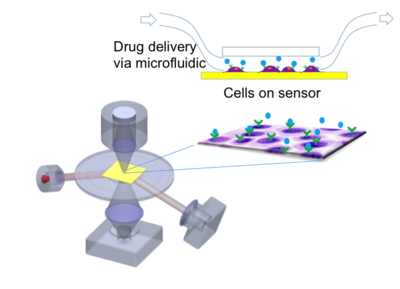
Figure2. Schematic diagram of the SPRm (Surface Plasmon Resonance Imaging) system
- Is it internalized? PathHunter® internalization assays use an enzyme-fragment complementation system. When the receptor–ADC complex is taken up into endosomes, two enzyme fragments come together and produce a luminescent signal proportional to the extent of internalization. The format is homogeneous and no-wash, and allows direct comparison of ADCs and parent antibodies.
- Does it kill the target cells? KILR® payload cytotoxicity assays detect cell death through the release of a reporter protein from dying cells, which generates a luminescent signal proportional to killing.
- What is the role of the immune system? The KILR® ADCC and ADCP assays measure whether the antibody’s Fc region can also recruit effector cells, which either kill the target cell (ADCC) or engulf it (ADCP). This helps separate immune-mediated killing from payload-driven killing.
Key takeaways
- A streamlined, end-to-end workflow enables multi-mechanistic ADC characterization.
- SPRM speeds up the assessment of target-specific binding and kinetics.
- It is possible to customize existing assays and much more.
Join the webinar
On November 12 at 8:00 am PT (5:00 pm CET), Jane Lamerdin, Vice President of R&D in Eurofins DiscoverX will show how integrated cell-based assays can characterize ADC mechanisms of action and generate functional insights to support candidate prioritization and preclinical development. The webinar will include SPRM data for the CD33 and BCMA targets.
Topics covered:
- Characterizing ADC internalization and lysosomal trafficking using functional cell-based assays
- Distinguishing payload-mediated cytotoxicity from Fc-mediated effects
- Applying functional data to compare and prioritize ADC candidates
- Using mechanism-resolved characterization to inform preclinical optimization and development
Register here: Dissecting the Biology Behind Antibody-Drug Conjugates