


Cryogen-Free Optical Cryostat Family for Low-Temperature Optical Measurements – OptiCool®
OptiCool® Family of Instruments from Quantum DesignThe OptiCool® Family of Instruments is a cryogen-free optical cryostat platform for low-temperature optical, electrical, and magneto-optical measurements. The family includes three configurations: OptiCool® 7 Tesla, OptiCool® Vector, and OptiCool® Flex.
OptiCool® 7 Tesla combines optical access with a superconducting 7 T split-coil magnet for high-field magneto-optical experiments. OptiCool® Vector adds vector magnet control for precise field orientation relative to the sample and optical setup. OptiCool® Flex is the magnet-free configuration for experiments that require maximum optical and experimental access, including a large sample volume of 75 × 200 mm.
The cryogen-free platform is designed for automated temperature control from 1.7 K to 350 K and low-vibration performance below 10 nm peak-to-peak. Depending on the selected configuration, researchers can combine low-temperature operation with high magnetic fields, vector magnetic field control, or an open magnet-free geometry for flexible optical experiments.
- Temperature range: 1.7 K to 350 K
- Three configurations: OptiCool® 7 Tesla, OptiCool® Vector, OptiCool® Flex
- 7 T split-coil conical magnet, 4-1-1 vector magnet, or magnet-free configuration
- Automated control of temperature and magnetic field
- Low vibration: <10 nm peak-to-peak
- Large sample volume up to 75 × 200 mm with OptiCool® Flex
- Cryogen free operation
- Multiple optical access ports for transmission, reflection, microscopy, and spectroscopy experiments
Further information
OptiCool® Family of Instruments
The OptiCool® Family of Instruments provides a configurable cryogen-free platform for optical experiments at low temperatures. The system is mounted on an optical table and can be integrated into a wide range of spectroscopy, microscopy, and magneto-optical measurement setups.
Three configurations are available:
OptiCool® 7 Tesla
OptiCool® Vector
OptiCool® Flex
OptiCool® 7 Tesla is the standard high-field configuration with a superconducting 7 T split-coil magnet. OptiCool® Vector provides a 4-1-1 vector magnet for experiments that require precise control of the magnetic field direction. OptiCool® Flex is the magnet-free configuration with a larger sample volume and open experimental access for custom low-temperature optical setups.
Magnet and Optical Access
OptiCool® 7 Tesla uses a superconducting 7 T split-coil magnet. The magnetic field is aligned perpendicular to the optical table and provides high field homogeneity over the sample region. The system includes seven side optical access ports and one top optical access port. An optional bottom port is available.
OptiCool® Vector uses a superconducting 4-1-1 vector magnet. The 4 T magnetic field is perpendicular to the optical table, while the two 1 T magnetic field components are parallel to the optical table. This enables precise alignment of the magnetic field relative to the sample and the optical system. The configuration includes four side ports along the X and Y axes and one top port along the Z axis. An optional bottom port is available.
OptiCool® Flex is the magnet-free configuration of the OptiCool® Family of Instruments. It maximizes experimental access with eight optical access ports, including seven side ports, one top port, and an optional bottom port. The large 75 × 200 mm sample volume supports customized low-temperature optical experiments, larger sample environments, and setups that require additional space around the sample.
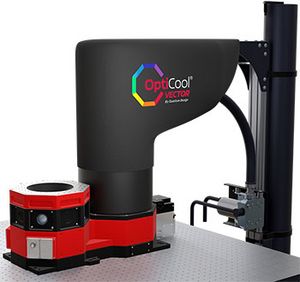
Models
| OptiCool® 7 Tesla | OptiCool® Vector | OptiCool® Flex | |
| Magnetic Field: | 7 T split-coil conical magnet | 4-1-1 T vector magnet (Z-X-Y) | None |
| Optical Access Ports: | 8 ports:
| 5 ports:
| 8 ports:
|
| Sample Volume: | 84 × 89 mm | 84 × 89 mm | 75 × 200 mm |
| Temperature Range: | 1.7 K to 350 K | ||
| Low Vibration: | <10 nm peak-to-peak | ||
| Temperature and Magnet Control: | Automated | ||
| Cryogen: | Cryogen free | ||
Sample Pods
The OptiCool® sample pod provides a dedicated space to build and customize experiments on the bench before inserting them into the cryostat. Multiple experiments can be prepared on separate pods and exchanged efficiently, reducing setup time between measurements.
Sample pods are available in standard and large-volume configurations. Depending on the experiment, the mounting plate height can be adjusted using interchangeable riser pieces. This enables flexible integration of samples, optical components, wiring, nanopositioners, and custom experimental hardware.

- Standard Sample Pod – Allows for mounting plate positions from 56.4 mm to 12.4 mm below the magnet center.
- Large-Volume Sample Pod – Allows for mounting plate positions from 131 mm below to 87 mm below the magnet center.
Wiring
The OptiCool can be custom configured with three different types of wiring assemblies. Each cryostat can have up to 5 wiring assemblies pre-installed. The wiring assemblies present the necessary connectors to make contact to the pod and take care of thermal lagging, necessary to reach base temperature.
- Sample Wiring – Each sample wiring assembly contains eight twisted pairs for a total of 16 wires. Four 4-pin connectors are presented on the pod to make contact to your sample.
- Positioner Wiring – The positioner wiring assembly is designed to be compatible with attocube piezo positioner stacks. Each assembly has enough wires to run up to 3 different axes of motion with the RES position feedback. If position feedback is not required, the feedback wires can be repurposed to run an additional 3 axes of motion. Contact Quantum Design for more information.
- RF Coax Wiring – The RF coax wiring assembly contains four coaxial cables capable of carrying high frequency signals up to 20 GHz.
Positioning and Microscopy
Many optical applications require precise positioning of the sample to the optical path for focusing or examination of an area of interest. The ability to scan the sample is also required for 2D imaging of sample properties. To meet these needs the OptiCool cryostat can be configured with a piezo-based nanopositioning stack to move your sample in situ. The nanopositioner option comes with all the adapters needed to mount the nanopositioners onto a pod, specialized cryostat wiring, and cabling that can connect to the piezo controller. The nanopositioner stack can be mounted on the standard pod or on the large-volume pod depending on experimental needs.
Many experiments require a high-quality, high-NA objective. To address this need, Quantum Design offers a field-compatible Zeiss 100x LD EC Epiplan-Neofluar, infinity-corrected objective. With a 0.75 NA and a free working distance of 2 mm between your sample and the cold shield aperture, the optics are maintained in vacuum at room temperature to provide the optimal environment to take full advantage of this objective's high performance design.
 OptiCool nanopositioner on large-volume pod
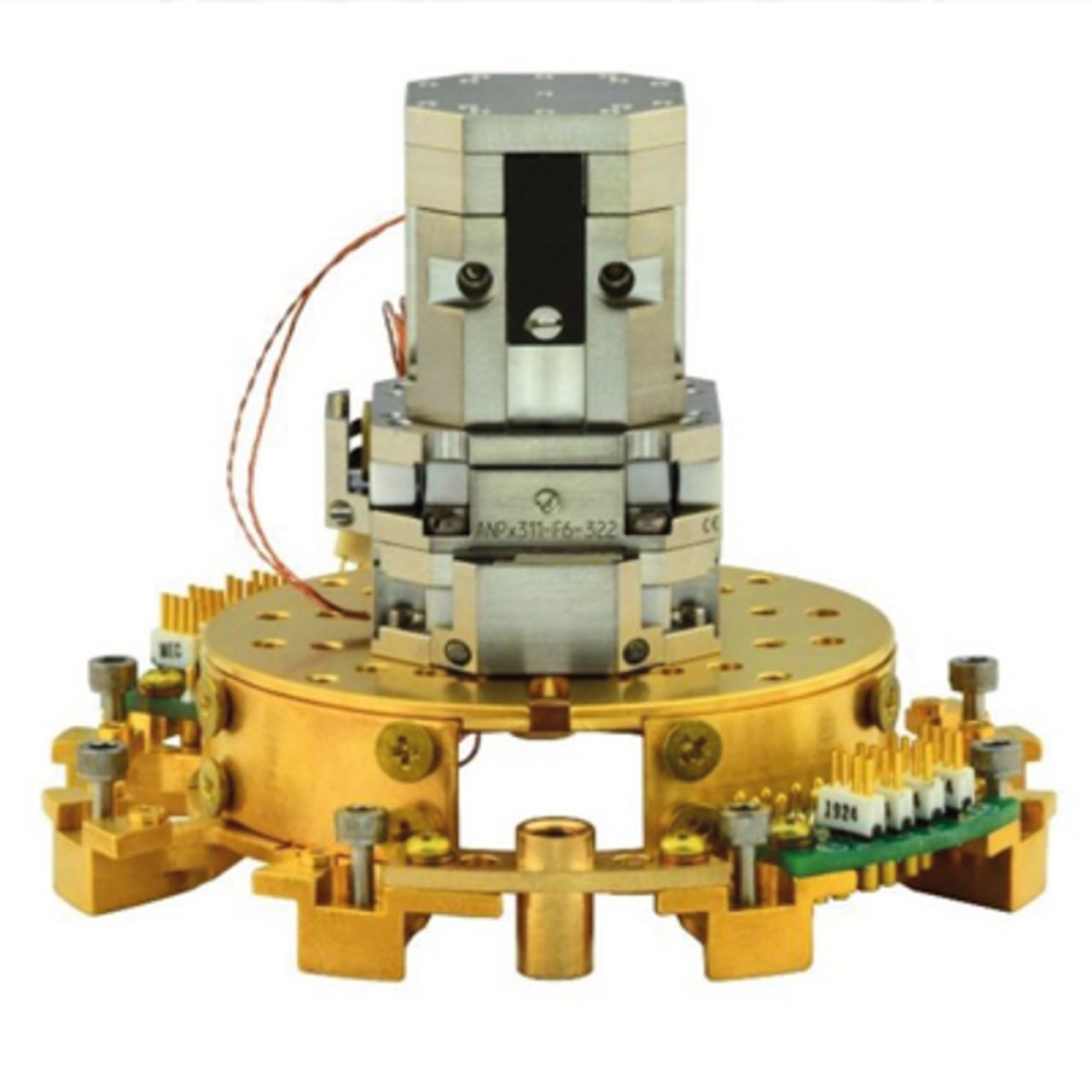 OptiCool nanopositioner on standard pod
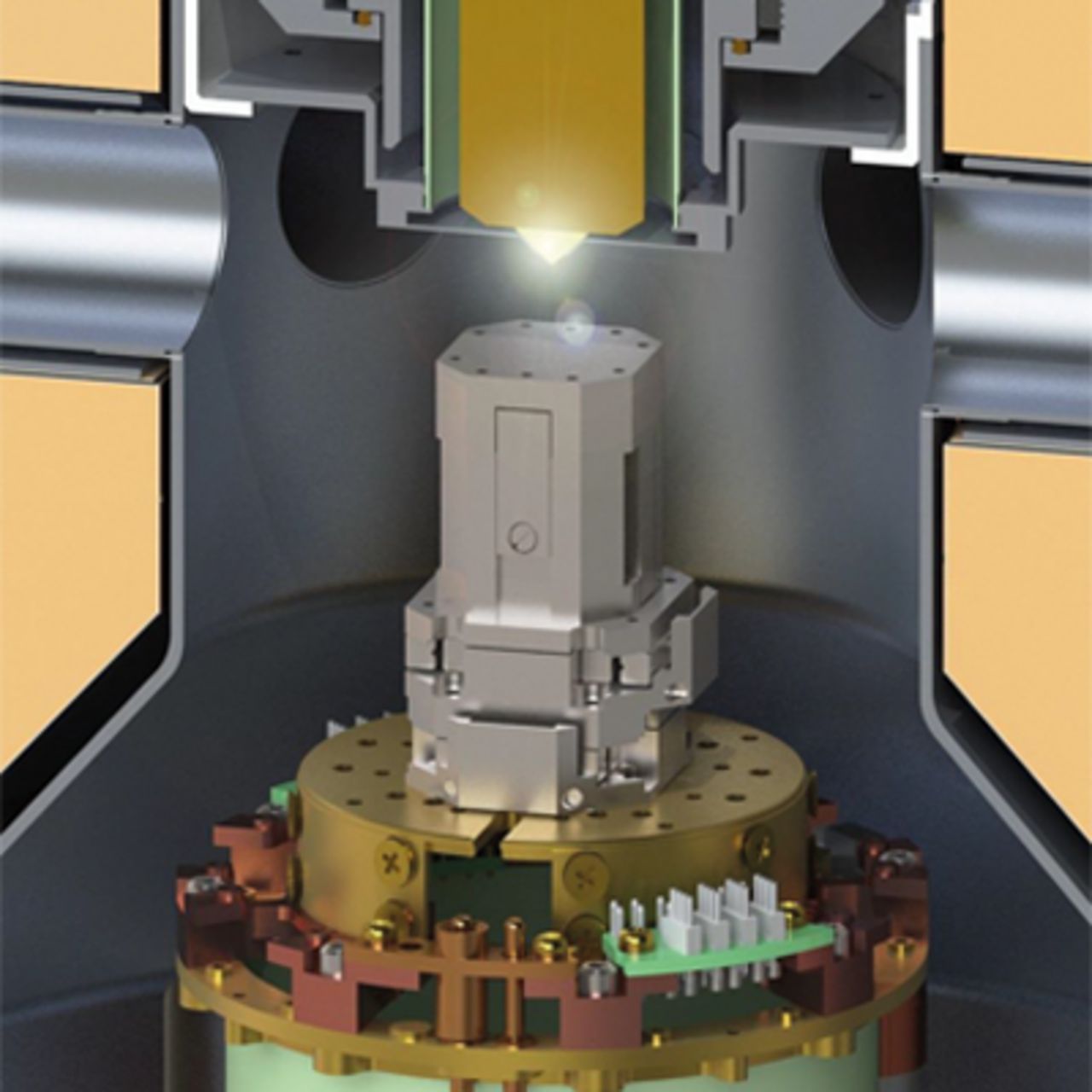 OptiCool room temperature objective
Applications
- MOKE / CryoMOKE
- Raman / FTIR spectroscopy
- Photoluminescence
- UV / VIS reflectivity & absorption
- AFM / Microscopy
- Diamond NV Centers / Color Defect / Voids
- Nanomagnetism / Magnetic thin films
- Time-resolved magnetic spectroscopy
- Quantum optics
- Spintronics
- 2D materials (such as transition metal dichalcogenides)
- Anisotropic magnetic single crystals
- Magneto-excitons
Downloads



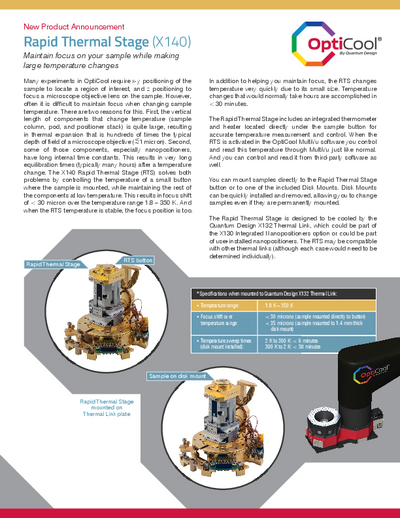

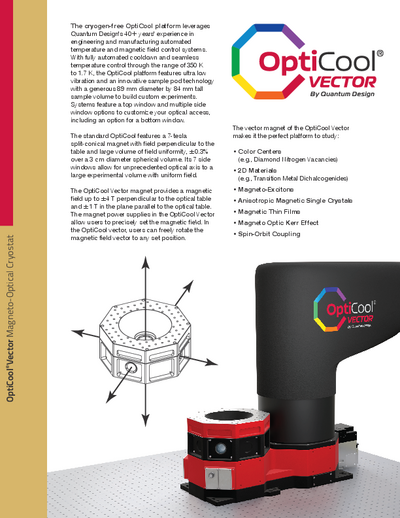
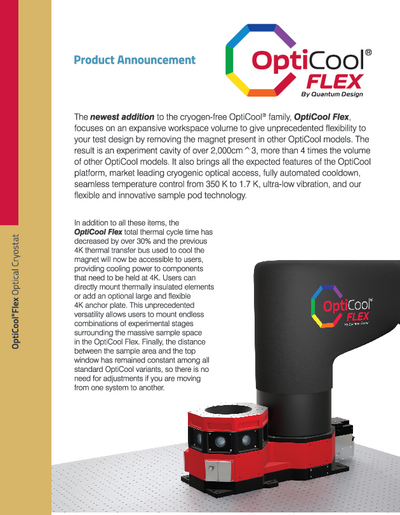
Videos

Perfect Coulomb drag and exciton transport in an excitonic insulator.
R. Qi et al., Science 388, 278 (2025)
Coherent manipulation of photochemical spin-triplet formation in quantum dot–molecule hybrids.
M. Liu et al., Nature Materials (2025)
Axial Ligand Lability and Coordination Induced Spin State Variations of Tetracarbene Iron(II) Thiolato Complexes.
I. Becker et al., Eur J Inorg Chem (2025)
Observation of the magnonic Dicke superradiant phase transition.
D. Kim et al., Sci. Adv. 11 (2025)
Photocurrent Nanoscopy of Quantum Hall Bulk.
R. Jing et al., Phys. Rev. X 15 (2025)
Viscous terahertz photoconductivity of hydrodynamic electrons in graphene.
Kravtsov, M., Shilov, A.L., Yang, Y. et al., Nature Nanotechnology (2024)
High-Mobility Compensated Semimetals, Orbital Magnetization, and Umklapp Scattering in Bilayer Graphene Moiré Superlattices.
Shilov, A. et al., ACS Nano (2024)
Infrared nano-imaging of Dirac magnetoexcitons in graphene.
Dapolito, M., Tsuneto, M., Zheng, W. et al., Nature Nanotechnology (2023)
Correlated Insulator of Excitons in WSe₂/WS₂ Moiré Superlattices.
R. Xiong et al., Science 380, 860 (2023)
Magnetoelectric Coupling in Multiferroics Probed by Optical Second Harmonic Generation.
S. Xu et al., Nature Communications 14 (2023)
Axion Optical Induction of Antiferromagnetic Order.
J.-X. Qiu et al., Nature Materials (2023)
Creation of Chiral Interface Channels for Quantized Transport in Magnetic Topological Insulator Multilayer Heterostructures.
Y.-F. Zhao et al., Nature Communications 14 (2023)
Layer-Dependent Optically Induced Spin Polarization in InSe.
J. Nelson et al., Physical Review B 107 (2023)
Large Exchange Coupling Between Localized Spins and Topological Bands in MnBi₂Te₄.
H. Padmanabhan et al., Advanced Materials 34, 2202841 (2022)
Intralayer charge-transfer moiré excitons in van der Waals Superlattices.
M. H. Naik et al., Nature 609 (2022), pp. 52–57
Correlated interlayer exciton insulator in heterostructures of monolayer WSe₂ and moiré WS₂/WSe₂.
Z. Zhang et al., Nature Physics (2022)
High-Symmetry Anthradithiophene Molecular Packing Motifs Promote Thermally Activated Singlet Fission.
G. Mayonado et al., J. Phys. Chem. C 126 (2022), pp. 4433–4445
Reversible strain-induced magnetic phase transition in a van der Waals magnet.
J. Cenker et al., Nature Nanotechnology 17 (2022), pp. 256–261
Interlayer magnetophononic coupling in MnBi₂Te₄.
H. Padmanabhan et al., Nature Communications 13 (2022)
Spin photovoltaic effect in magnetic van der Waals heterostructures.
T. Song et al., Science Advances 7 (2021)
Evidence for a monolayer excitonic insulator.
Y. Jia et al., Nature Physics 18 (2021), pp. 87–93
Magnetoelastic coupling to coherent acoustic phonon modes in the ferrimagnetic insulator GdTiO₃.
D. J. Lovinger et al., Phys. Rev. B 102 (2020)
Contact

Navigation
Categories
Contact
Quantum Design
Str Ion Nistor 4, et 1, M2E
030041 Bucharest
Romania
| Phone: | +40 755039900 |
| Fax: | +40 317107156 |
| E-mail: | romaniaqd-europe.com |
Support