
Introducing the Bentham FCH Fibre-Coupled Optical Homogeniser for high-throughput, spatially uniform square flat-top illumination
Quantum Design Italy is pleased to announce the launch of the new Bentham FCH Fibre-Coupled Optical Homogeniser. Designed specifically for researchers and industry professionals demanding both high irradiance and exceptional spatial uniformity, this microlens-array (MLA) based system converts fibre-delivered broadband or monochromatic light into large, square, flat-top illumination fields at the sample plane.
Advanced microlens-array architecture across a broad spectral range
The FCH Homogeniser operates over a wide spectral range spanning from 200 nm to 2.5 µm. By utilizing an advanced microlens-array core design, the device delivers a highly uniform, square spatial profile with a whole-field spatial uniformity of U2 ≥ 98%. For precision calibration tasks, large contiguous regions within the projected field achieve an advanced uniformity threshold of U2 ≥ 99%.
This square flat-top distribution simplifies alignment procedures with sensors, cells, and camera field of view. It also significantly minimizes local illumination artifacts and reduces structural measurement sensitivity to sample placement.
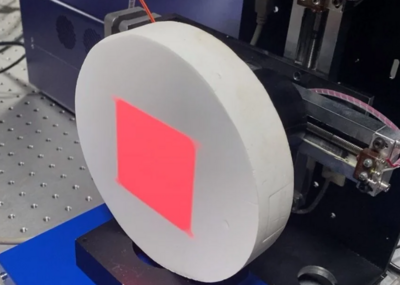
Figure 1. Square flat-top illumination
High optical throughput: overcoming integrating sphere losses
A key design benefit of the FCH series is its high optical efficiency compared to traditional uniform light alternatives.
Conventional setups utilizing integrating spheres encounter significant optical losses; for example, a representative configuration based on a 6-inch diameter sphere with a 2.5-inch exit port and a 420 mm working distance yields less than 0.5% throughput at the usable patch.
In contrast, the Bentham FCH circumvents these high losses, achieving an efficient usable-patch throughput of approximately 50% (measured typical at 550 nm). This allows researchers to maximize the transmission of available fibre-coupled source power directly onto detectors, omnidirectional cameras, or photovoltaic devices without compromising spatial homogeneity.
Standard configurations & modular options
The instrument is structured using two modular opto-mechanical blocks—an input block and an output block—allowing users to select the appropriate input fibre configuration and required projection area:
- FCH-500: Projects a 60 mm × 60 mm square field at a 500 mm working distance.
- FCH-1000: Projects a 120 mm × 120 mm square field at a 1000 mm working distance.
Both versions can be configured with either a single passive optical input (ideal for fixed installations with no moving parts or power requirements) or a motorised dual-input port block. The motorized configuration permits users to switch reproducibly between two separate fibre-coupled sources from the front panel or via USB control without disturbing the optical alignment. It features integrated status LEDs equipped with a dark mode option.
Target application areas
The high-throughput, high-uniformity characteristics of the FCH series suit a variety of industrial and scientific fields:
- Detector characterisation: empowers precision mapping of detector responsivity, linearity, saturation thresholds, spatial uniformity, and spectral response.
- Camera and image-sensor testing: provides a flat, repeatable field to conduct pixel-response uniformity evaluations, flat-field correction, vignetting analysis, and spectral sensitivity tests.
- Solar-Cell QE/EQE research: delivers stable, consistent irradiance over cell or sub-cell areas to increase reliability in wavelength-dependent Quantum Efficiency measurements.
- Hyperspectral & multispectral imager calibration: implements stable radiometric calibration, channel-to-channel comparisons, and spatial-response corrections across the device field of view.
- Sample-plane illumination: ideal for test samples, custom sensors, optical assemblies, or remote-sensing verification tasks needing highly predictable area illumination.
System Integration
The system integrates perfectly with Bentham's full line of tuneable light-source systems, including the FTMC100-LDS high-power tuneable source (optimized for laser-driven Xenon sources), the FTMC50-SCL supercontinuum-laser tuneable source, and the FTMC50V high-efficiency fibre-to-fibre monochromator.
Would you like to learn more about this instrument or see it in action in your laboratory?
Contact Gianluca Zocchi