Photobiological Safety of Lighting Fixtures: Simplifying Blue Light Risk Testing with the Bentham ISR300-PSL
Is a lighting fixture safe for the eyes of its users? For manufacturers of these systems, answering this question is a fundamental part of the design and marketing process. Photobiological safety, in fact, is not limited to laser or ultraviolet sources: even conventional lighting fixtures can pose potential risks to the skin and eyes, depending on the characteristics of the emitted radiation and the exposure conditions.
To assess these risks, the IEC/EN 62471 standard defines measurement procedures and exposure limits for various types of optical radiation. The Bentham ISR300-PSL is a spectroradiometer designed specifically to simplify the assessment of retinal exposure to blue light, providing manufacturers with a tool to perform direct and accurate measurements.
Why Photobiological Safety Is Important
Optical radiation emitted by a light source can pose various health risks, depending on the wavelength and intensity of exposure.
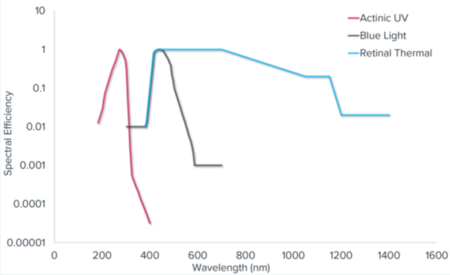
The IEC 62471 standard identifies six main risk categories, including:
- Actinic UV radiation, associated with potential damage to the skin and eyes.
- Near-UV radiation, which can primarily affect the lens of the eye.
- Blue light, which can cause photochemical damage to the retina (photoretinitis).
- Retinal thermal radiation, which can cause retinal burns.
- Infrared radiation, associated with potential damage to the cornea and the lens of the eye.
- Thermal risk to the skin.
Source: Bentham "Photobiological Safety of Lamps and Lamps Systems"
Among these, the blue light hazard is particularly relevant for LED lighting manufacturers, as it concerns the potential exposure of the retina to radiation in the spectral range between 300 and 700 nm.
The four risk classes: RG0 through RG3
To classify the photobiological safety of light sources, IEC 62471 introduces a four-level system based on the permissible exposure time before the specified exposure limits are exceeded.
The four categories are:
- RG0 – Exempt: The light source poses no photobiological risks under the evaluation conditions considered.
- RG1 – Low Risk: poses no risk under normal conditions of user behavior.
- RG2 – Moderate Risk: the risk is limited by the eye’s natural reaction to intense light (aversion reflex) or by thermal discomfort.
- RG3 – High Risk: the light source may pose a hazard even in the case of momentary exposure.
This classification considers the characteristics of the source, the intensity of the radiation, and the exposure time. In the case of risks to the retina, the eye’s natural response, such as eye movements and the aversion reflex, is also considered.
For manufacturers, correctly identifying the risk group is essential for assessing product safety and determining any protective requirements, warnings, and information to be provided to users.
How to assess the risk associated with blue light
When assessing photobiological risks, the choice of which quantity to measure depends on the affected tissue: for the skin and the anterior segment of the eye, spectral irradiance is assessed, while for the retina (including damage from blue light), spectral radiance is used.
This distinction is important because, while irradiance considers the light reaching a surface (energy per unit area), radiance allows for the assessment of radiation emitted by the light source in the direction of observation as a function of solid angle.
The measurement distance is also a key factor and depends on the intended application:
- For luminaires intended for general lighting (GLS), the assessment is based on the distance at which the light source produces an illuminance of 500 lux.
- For light sources intended for applications other than general lighting (non-GLS), the measurement is taken at 200 mm from the apparent light source.
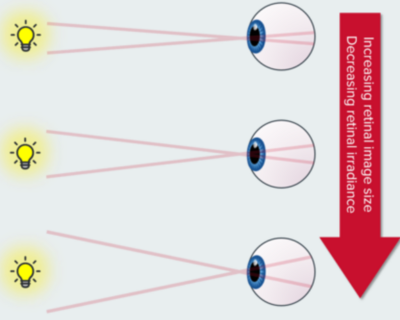
Furthermore, in cases involving a risk to the retina, the assessment must take into account the apparent size of the light source and eye movements during exposure. For this reason, the instrument’s field of view and the measurement distance are essential parameters for obtaining representative results.
Source: Bentham "Photobiological Safety of Lamps and Lamps Systems"
Why perform a direct measurement
For lighting fixture manufacturers, assessing the risk posed by blue light can present several challenges:
- The data provided by LED manufacturers is not sufficient, on its own, to characterize the photobiological safety of the fixture.
- Measurements require specialized instruments and technical expertise.
- Estimation procedures can be overly conservative, leading to a risk assessment that is higher than the actual risk.
- Using external laboratories can result in additional costs and delays during product development.
A direct measurement of blue light radiance allows for the characterization of the luminaire’s actual emission under the intended viewing conditions, reducing the uncertainties associated with indirect methods.
Bentham ISR300-PSL: a direct solution for blue light risk testing
The Bentham ISR300-PSL is a spectroradiometer designed to directly measure the radiance of blue light emitted by lighting fixtures using a telescopic optical system.
The instrument allows for measurements starting at 200 mm and at greater distances, making it suitable for evaluating various types of light sources, from indoor LED fixtures to high-power outdoor floodlights.
Thanks to direct measurement, manufacturers can obtain a more accurate characterization of light emission, avoiding reliance solely on indirect estimates that could overestimate the risk and unnecessarily influence design and commercial decisions.
Calibration is also traceable to the PTB (Germany), ensuring the reliability and quality of the measurements.
Two application examples
Measurements taken with the ISR300-PSL demonstrate how the instrument can be used to evaluate lighting fixtures with very different characteristics.
1. Indoor LED fixture
In the first case, the measurement allowed the fixture to be classified as Risk Group 1 (RG1), confirming compliance with the relevant limit under the evaluation conditions considered.
2. Outdoor LED spotlight
In the second case, the spotlight exceeded the RG1 limit at a distance of 200 mm. The measurement allowed for the determination of a threshold distance (dthr) of 2.4 m, beyond which the RG1 limit is met.
This result provides concrete guidance for defining installation conditions and any precautions to be communicated to users, thereby preventing prolonged exposure at close range.
The main advantages of the ISR300-PSL
- Direct measurement: It measures the radiance of the blue light emitted by the source, allowing you to verify the data provided by LED manufacturers.
- Wide range of applications: Suitable for various types of products, from decorative indoor lighting fixtures to high-power outdoor floodlights.
- Ease of use: Does not necessarily require a darkroom or in-depth knowledge of regulatory procedures.
- Portability: Compact and easily transportable design.
- Automation: Dedicated software that guides the operator through measurements and reports key parameters, including blue light radiance, luminance, Ethr, and dthr.
- Reliability: Calibration traceable to the PTB (Germany).
Would you like to simplify the blue light risk assessment for your lighting fixtures?
Find out how the Bentham ISR300-PSL can support the design, development, and photobiological safety testing of your products. Visit the product page or contact our expert, Gianluca Zocchi.
| +39 06 5004204 | |
| +39 06 5010389 | |
| gianluca.zocchiqd-europe.com |