
Good to know about KBr pellets
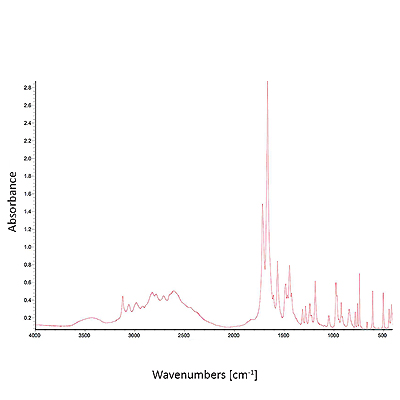
KBr pellet formation is a classic technique for the analysis of solids that retains attractive features over newer techniques such as ATR. The ability to change the pathlength of the compound of interest offers a substantial advantage.
Advantages:
- Use less sample than ATR
- Higher signal-to-noise
- Control signal intensity by changing sample concentration or by increasing the pathlength by adding extra sample and KBr to the pellet die. The intensity increases as the mass increases. In accordance with the Beer-Lambert law absorbance increases linearly with the pellet mass which is proportional to pathlength. This gives the operator control over the peak intensities. When attempting to identify weak bands, possibly from trace contaminants, KBr pellets offer clear advantages with substantial improvements in limits of detection.
- No peak intensity correction required (in ATR spectroscopy the effectively pathlenth is dependent on the wavelength, resulting in changes of the relative band intensities and, for wide bands, in a shift of the absorption maximum)
- A variety of (commercial) spectra libraries
Further information
Preparation of pellets
Generally, it is easy to produce a good quality KBr pellet if an evacuable pellet die is used correctly. When the sample is added to the halide salt the clarity of the disc will depend to a large extent on the quantity and type of sample. For a 13mm diameter die 200 - 300 mg KBr and 1 mg sample at load of 8 tons are a good starting point. To ensure that a sample pellet is produced which will enable accurate spectra of samples to be obtained, it is essential that the sample is thoroughly blended with the halide salt powder. Blending can be achieved either by using a mortar and pestle or by using a grinding mill.
The overall quality of a pellet is largely dependent upon the quality of the KBr or halide salt powder used, which should always be of a spectroscopic grade of purity.
Good to know – Possible faults and remedy
However, some faults in the produced sample pellet may occur due to a variety of reasons. Some of these faults and their remedies are tabulated below. The faults described are for pure KBr or other halide salts which do not contaminate the sample.
| Fault | Cause | Remedy |
| Sample pellet not clear. Lacks optical clarity. | Sample damp, contaminated KBr powder or insufficient | Dry the KBr powder or sample and increase the compacting |
| Sample pellet is clear but shows opaque spots. | Powder not uniformly flat in the die, leaving large particles which do not vitrify when | Sieve powder to extract coarse grains, then re-grind and re-press. |
| Sample pellet is cloudy. | Insufficient evacuation time or leaky seals. | Check seals on the die and lengthen evacuation period. |
| Sample pellet is clear at first but quickly becomes cloudy. | Damp powder or damp atmosphere. | Dry the KBr powder or sample, |
Contact

Navigation
Categories
Contact
Quantum Design s.r.l.
Via di Grotta Perfetta, 643
00142 Roma
Italy
| Phone: | +39 06 5004204 |
| Fax: | +39 06 5010389 |
| E-mail: | italy@qd-europe.com |
Support