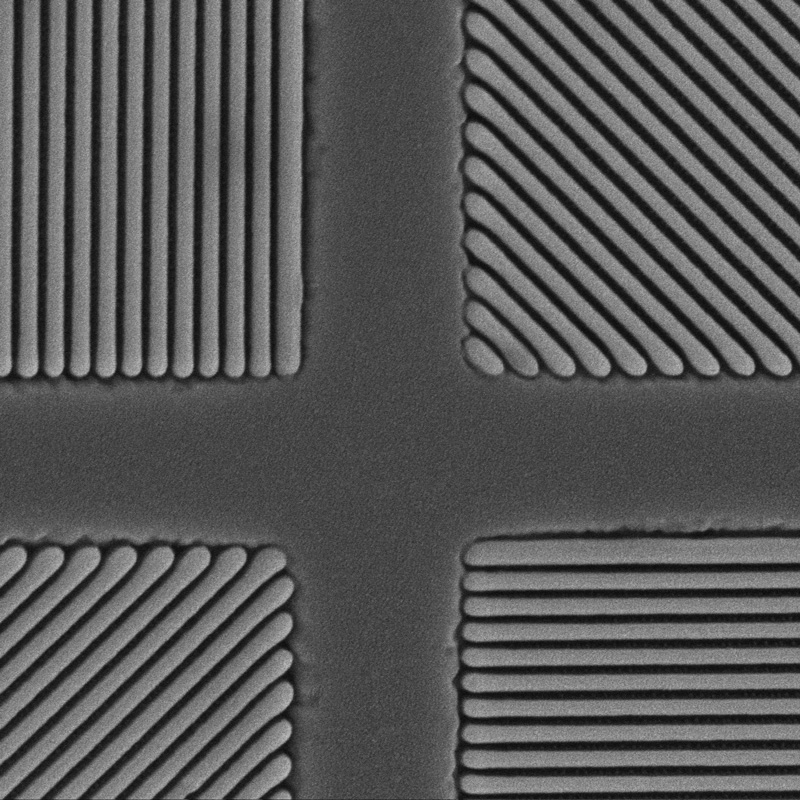


Optical Metasurfaces & Metalenses
from MoxtekMoxtek manufactures high-performance metal lenses for the visible and IR range. The offering includes design, prototyping, subsequent large-scale production on 200 mm wafers, documented measurement, and packaging.
The functional nanostructures can be used, for example, as microlens arrays, waveguides, structured metasurfaces and metalenes, diffractive optical elements (DOEs), photonic crystals, and biosensor arrays in the VIS or NIR range.
These components for imaging, lighting, and display systems are used, in the automotive industry, in medical and dental imaging, in camera systems, and in many other areas.
- Minimum CD: 70nm
- Minimum Space Gap: 70nm
- Thickness: ≤1,000nm
- Aspect Ratio: 12:1
- Meta Materials (preferred): Nb2O5, Al
- Meta Materials (other): Si, SiO2, Si3N4
- Substrate Thicknesses: 0.5mm to 1.6mm thick
- Substrate Types: Display glass, Fused Silica, Silicon, Sapphire
Further information
Metalens Benefits
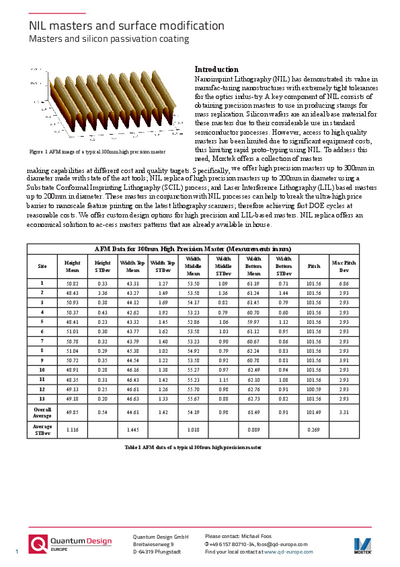
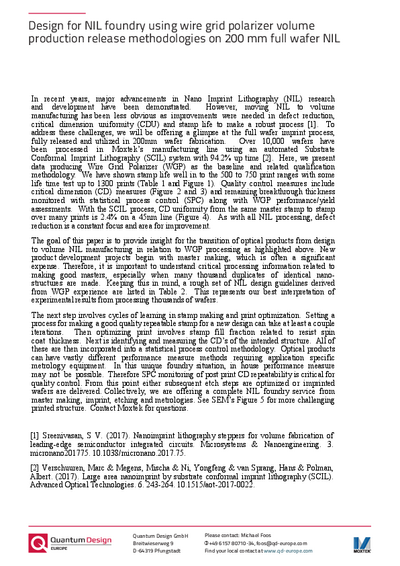
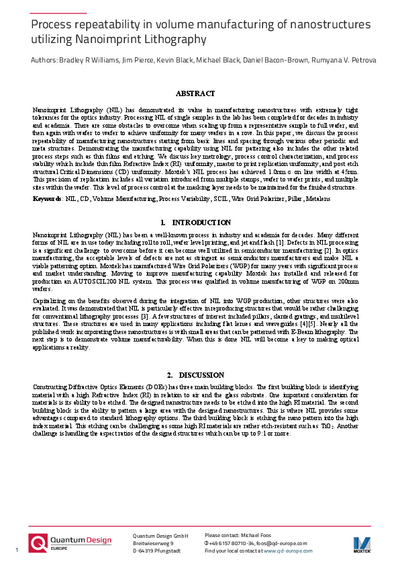
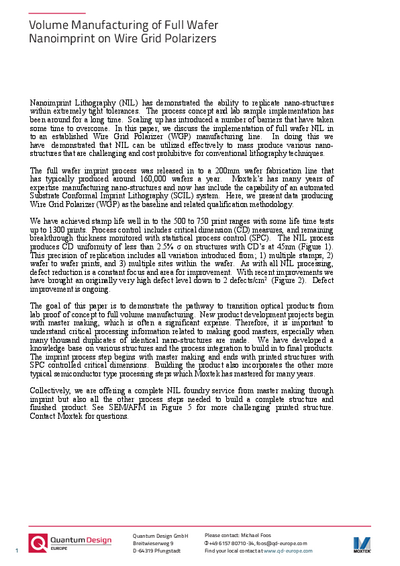
Metalens benefits include reduced track length and weight in optical systems. They can have more design flexibility, additional functionalities, shorter focal lengths and smaller diameters compared to traditional optics. Metalens micro-lens arrays (MLA’s) are also possible, with more design flexibility than traditional MLA approaches. As a meta- and nanostructured-optics company we have overcome various challenges associated with scaling up visible wavelength metalens manufacturing to production volumes. We have developed efficient methods to create replication masters combined with our existing NIL processing to provide a full solution approach to volume production. Moxtek replicates metalenses with extremely tight tolerances and high repeatability. Moxtek utilizes high aspect ratio etching into transparent films of high refractive index to achieve high performance metalenses.
Moxtek Advantages
- Production and prototype compatible processes
- In-house metalens modeling or the ability to replicate customer designs
- Expertise in thin-film deposition, etching, and NIL
- Niobium oxide (Nb2O5) visible meta-optics, with benefits including ease of deposition, low absorption, low roughness, uniform and high-aspect ratio etching, and stable optical properties
- Protective Overcoat™ enhances durability and performance
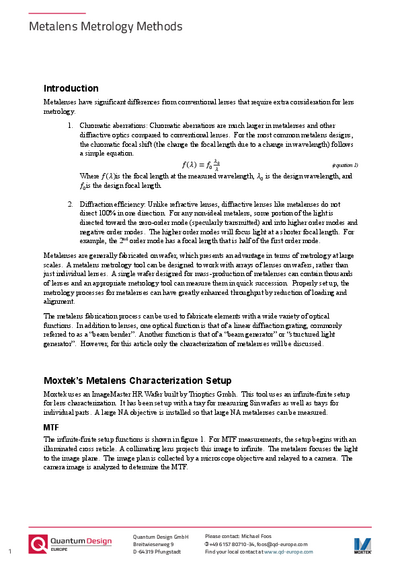
- Wafer-scale metrology capabilities including MTF, AFE, and Zero Order leakage
- Uniform lens replication using Ø200mm wafers
- >25 years of experience in manufacturing nanostructured optics

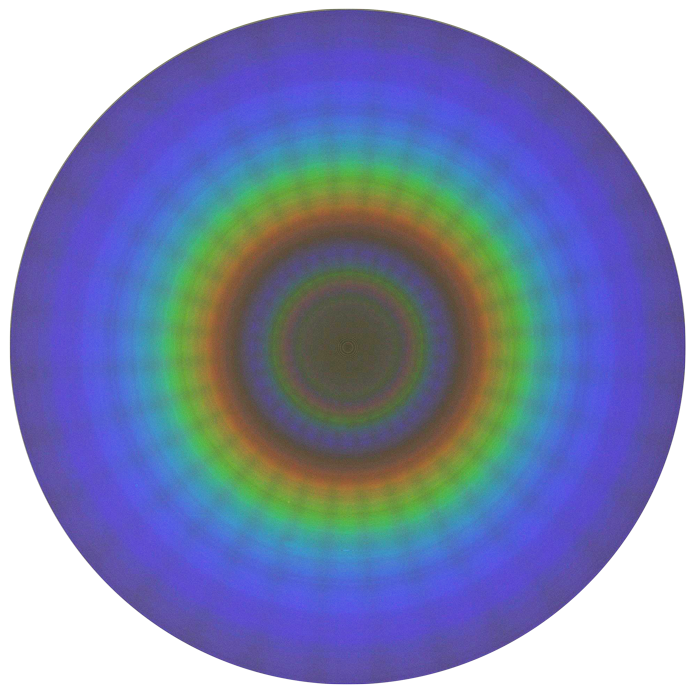
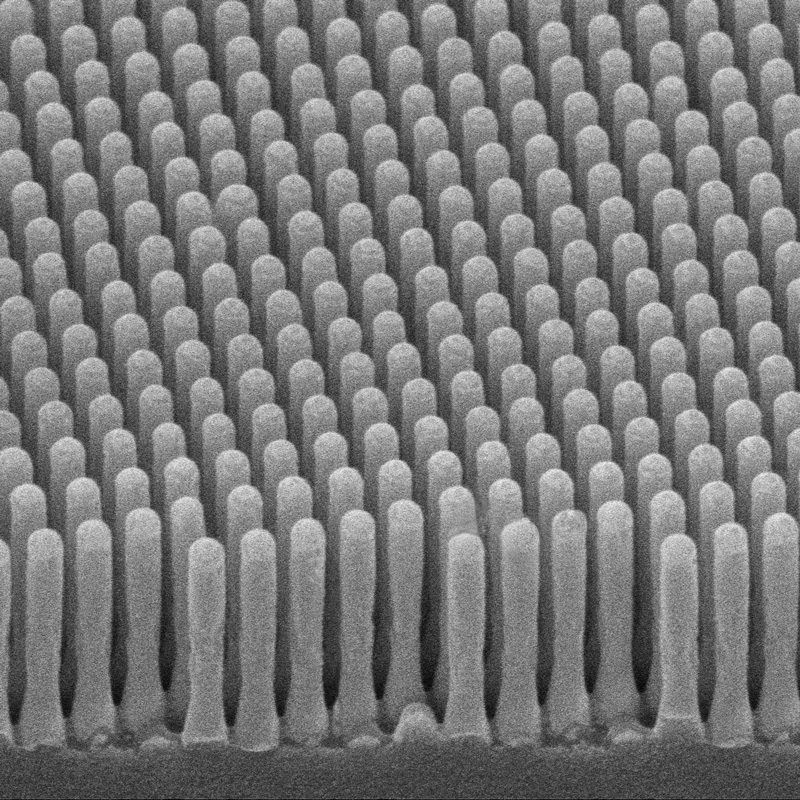
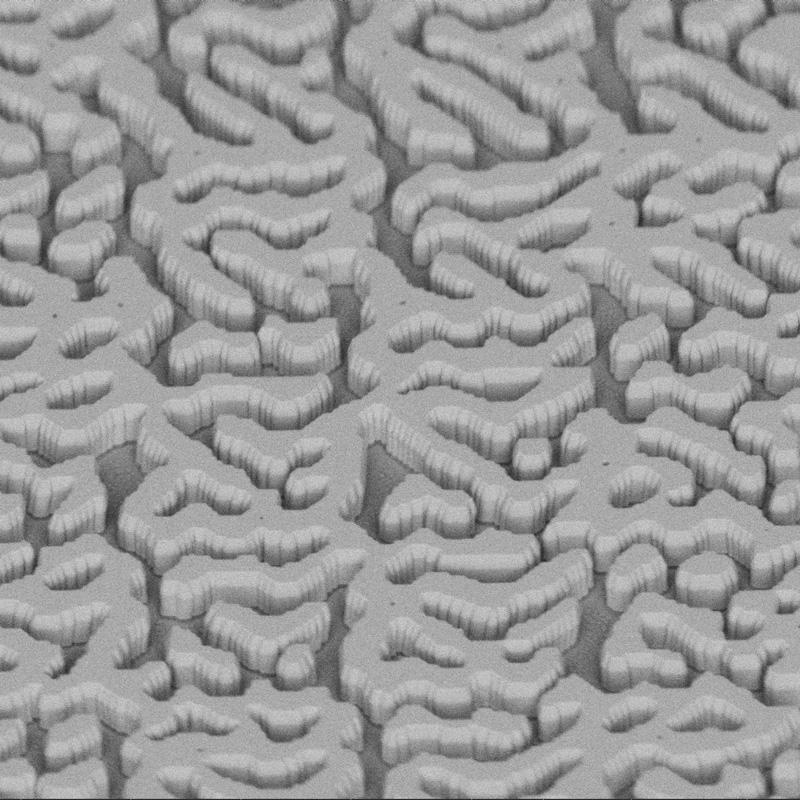
Figure 1: (a) Metalens imaged under microscope, (b) SEM view of center of metalens, (c-d) high aspect ratio Si and Nb₂O₅ nano-pillars, fabricated at Ø200 mm wafer.
Reliable Methods
Building on years of expertise, Moxtek has developed reliable methods to manufacture wafer-scale visible and near-IR metalenses for various emerging applications. Moxtek’s metalens Overcoat™ helps protect against physical damage and can boost transmission. An absorptive aperture can be applied to cut down on stray light back reflections. Reflective aperture options are also available. See our manufacturing design parameters below. For more information contact us. Visible metalens samples are also available for purchase.
Design Parameters
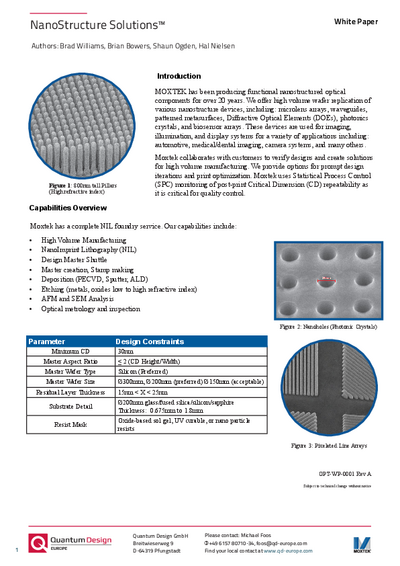
- Minimum Pillar CD and Gaps: 70nm
- Thickness: ≤1,050nm*
- Aspect Ratio: 15:1 or less
- Nanostructured Materials (preferred): Nb2O5, a-Si, Al
- Nanostructured Materials (development): SiO2, Si3N4, crystalline Si
- Other Thin Film Dielectrics: TiO2, Al2O3, ZrO2, etc.
- Other Thin Film Conductive Materials: Ag, ITO (development).
- Protective OvercoatTM: thickness can be optimized to reduce meta-structure reflectance, improving transmission and focusing efficiency.
- Substrate Diameter: Ø200mm
- Substrate Types: [1] Eagle XG display-grade glass, [2] Fused Silica, [3] Silicon, [4] Borofloat, [5] Sapphire (development only), [6] BK7 glass (development only)
- Substrate Thicknesses: 0.5mm[1], 0.7mm[1]-[3],[5]-[6], 1.0 mm[2], or 1.6mm[2]
Superscripts above denote the corresponding substrate types available for a given thickness. * Note: Greater thickness is possible when min CD is greater than 70 nm.
Visible & Near-IR Metalenses
Moxtek has produced a variety of visible and near-IR metalenses with different sizes, focal lengths, numerical aperture, and operating wavelengths. However, it has been difficult for businesses to explore the possibility of incorporating metalenses into their optical systems because metalenses are generally available on a custom-order basis only. To make this kind of evaluation easier, Moxtek is making visible and near-IR metalenses available off-the-shelf for benchtop and integration testing. These samples available for purchase are listed in the Metalens Datasheet. In addition, optical metasurface and optical system design software are important tools that allow companies to explore and optimize new designs and assembly concepts without an extensive and costly series of prototyping builds and complicated metrology. However, “Design for Manufacturability” and reliability are important considerations that are sometimes overlooked by the designer, as the software often does not constrain the meta-atoms, substrates, or other options based on fab-specific design rules and capabilities. To overcome this, a Process Design Kit (PDK), using foundry-proven meta-atom libraries, becomes an important tool to ensure a fab-friendly and manufacturable design.
Meta-optic PDK’s
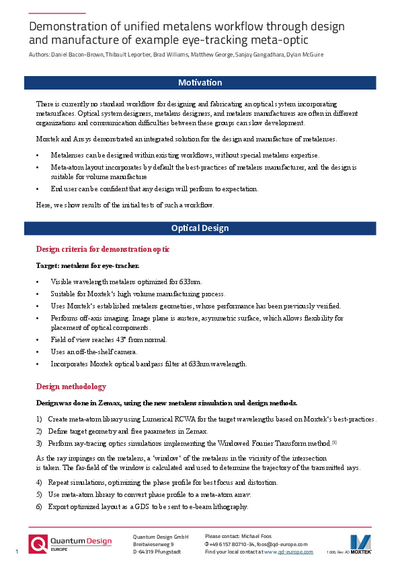
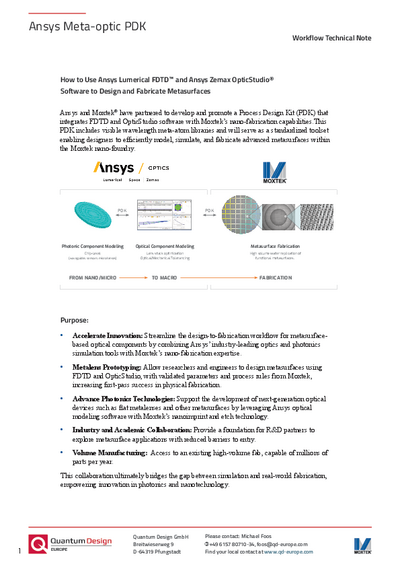
A Process Design Kit (PDK) is a collection of essential components, design rules, models, and data that help designers create semiconductor integrated circuits, or in this case metalenses and other meta-optics. Moxtek has worked with optical and photonic modeling software companies such as Ansys® and PlanOpSim to develop, validate and release visible meta-atom libraries, workflows, and associated files for the green (532 nm) and red (633 nm) wavelengths. The meta-atom libraries are optimized for and utilize our established visible meta-optic foundry processes, helping to ensure Fabrication-friendly designs. Moxtek has verified the Ansys PDK workflow and built and validated lens performance with a hyperbolic phase profile, and we have also used this workflow to replicate the design work from our published off-axis eye tracker demonstration.

Moxtek Advantages
- Uniform lens replication over Ø200mm wafer
- Production and prototype compatible processes
- Niobium oxide (Nb2O5) has proven beneficial in ease of deposition, uniform etching, and lower cost
- Ability to replicate customer designs
- Experience with thin-film deposition, etching, and NIL
- In-house metalens modeling
- Flexibility in lens parameters
- Protective overcoat enhances durability and performance
Downloads
Datasheets
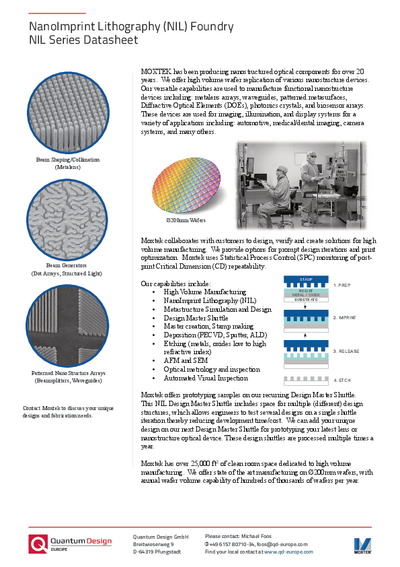
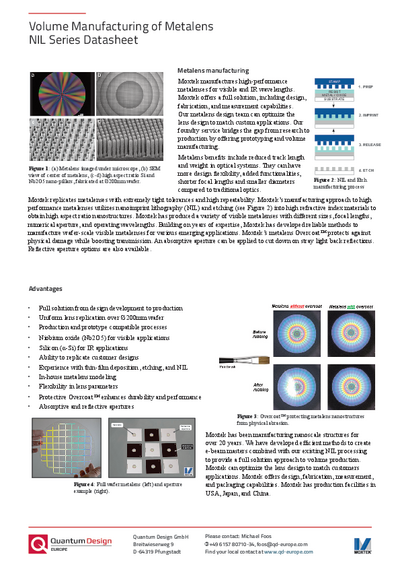
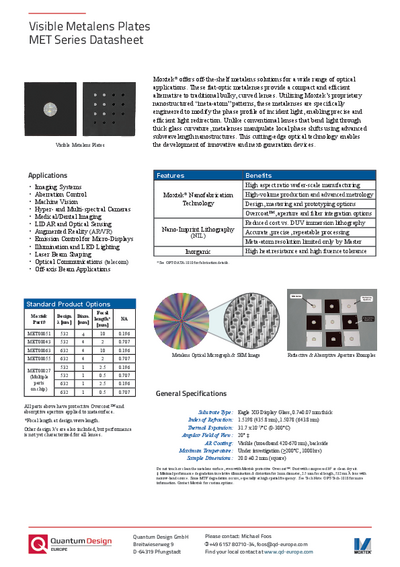
Technical Notes
Process Design Kit Workflow
Videos
Contact
| +49 6157 80710-34 | |
| +49 6157 80710934 | |
| Write e-mail |

Navigation
Categories
Contact
Quantum Design GmbH
Breitwieserweg 9
64319 Pfungstadt
Germany
| Phone: | +49 6157 80710-0 |
| E-mail: | germanyqd-europe.com |