
Why would I use a Polarizer in Spectroscopy?
To those with an interest in photography, polarization will be familiar as a method for eliminating specular reflections from the surface of water or glass, bringing out subsurface details in stunning clarity. However, in industrial applications polarization is often neglected.
Polarized light is useful because it enables selective measurement of samples that either alter the polarization state of the incident beam, or preferentially absorb one polarization of light over another; the former is the basis of ellipsometry and polarimetry techniques (among others), the latter is the basis of many infrared spectroscopic measurements with polarized light.
Further information
Parallel and perpendicular polarization
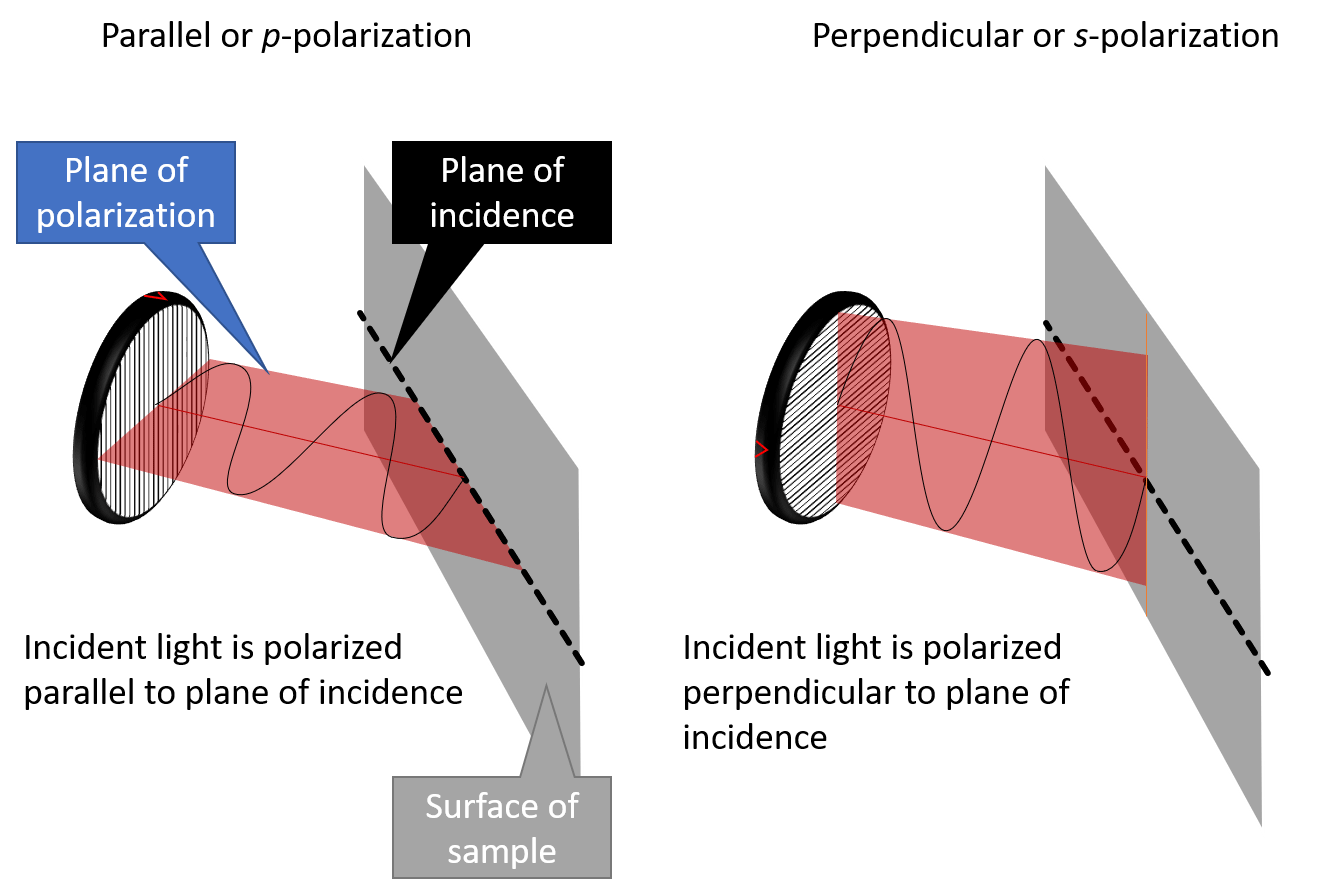
Linearly polarized light has its electric field confined to a plane. When this vector is aligned with the plane of incidence (the plane containing the incident, reflected, and transmitted rays at an interface) the light is said to be parallel, or p-polarized; when the vector is normal to the plane of incidence, the light is said to be perpendicular, or s-polarized.
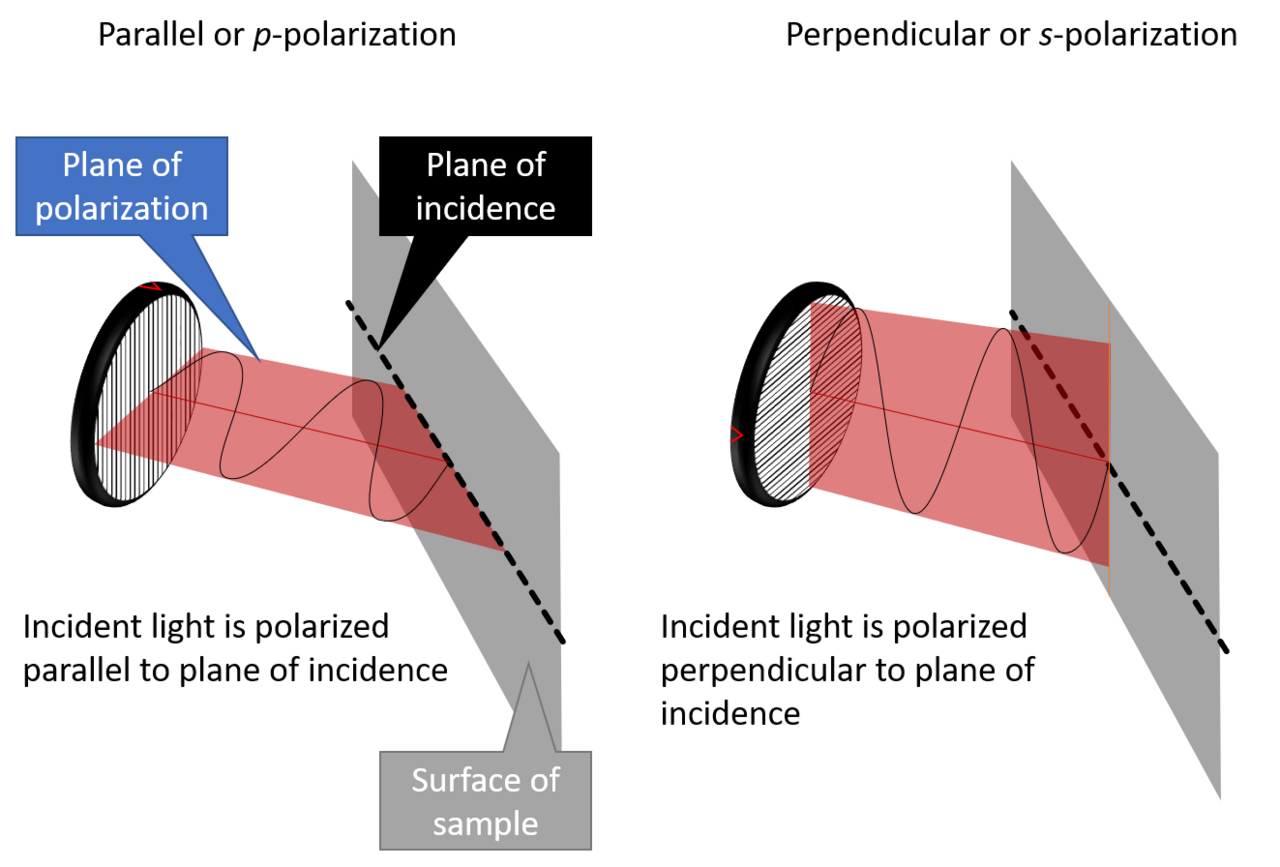
Anisotropy within samples can easily be explored by measuring alternately with parallel and perpendicularly polarized light and comparing the responses.
Crossed polarizers
Two polarizers with their grids oriented at 90˚ to one another are said to be ‘crossed’. This configuration should completely extinguish any light passing through the pair, since the first polarizer will filter out all polarizations capable of passing the second.
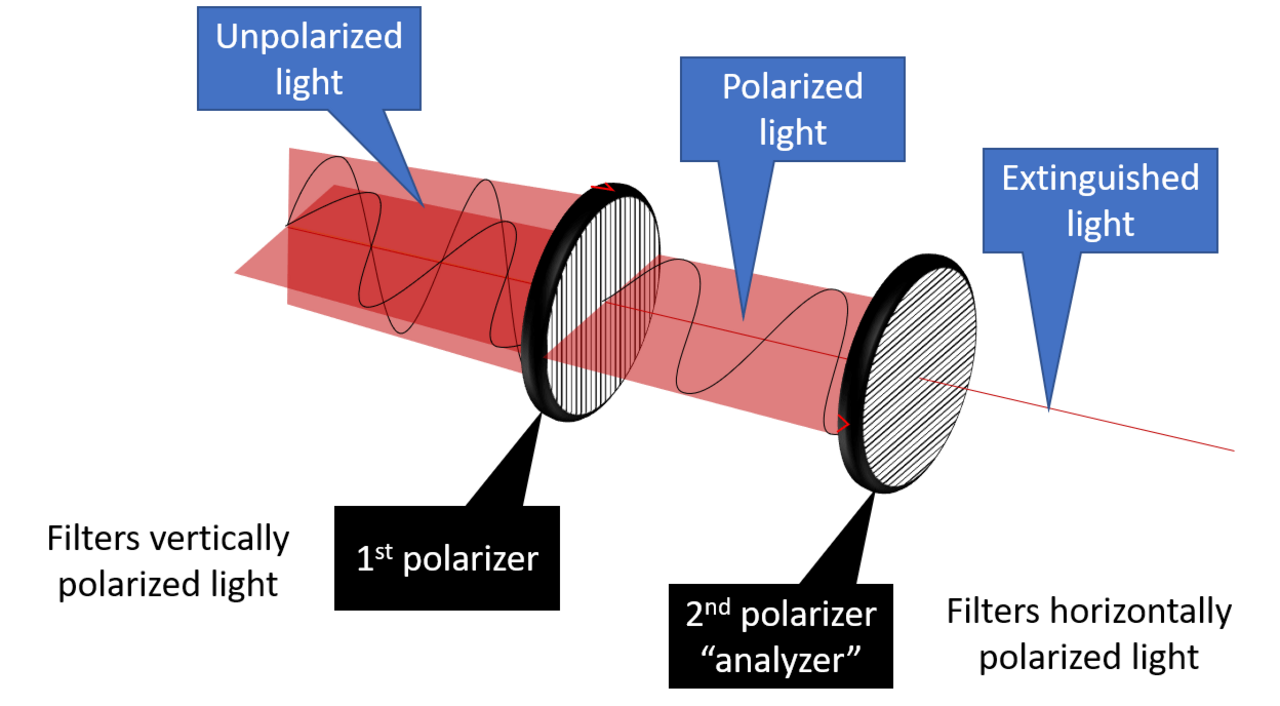
If a sample placed between the two polarizers alters the polarization state of the beam, then some light will now pass the analyzer. The analyzer can then be rotated until the beam is once again extinguished, and the necessary rotation angle is recorded as the polarization change induced by the sample.
Spectroscopic applications of infrared polarizers
Absorption of a polarized beam is maximized when its electric field is parallel to the electric dipoles in the sample. For a sample material where all molecular dipoles are oriented in the same direction, varying the polarization angle will yield minimum and maximum intensities for a given absorbance, giving information on the orientation of those molecules with respect to the beam. This is the key to many applications of polarizers.
Thin film measurement
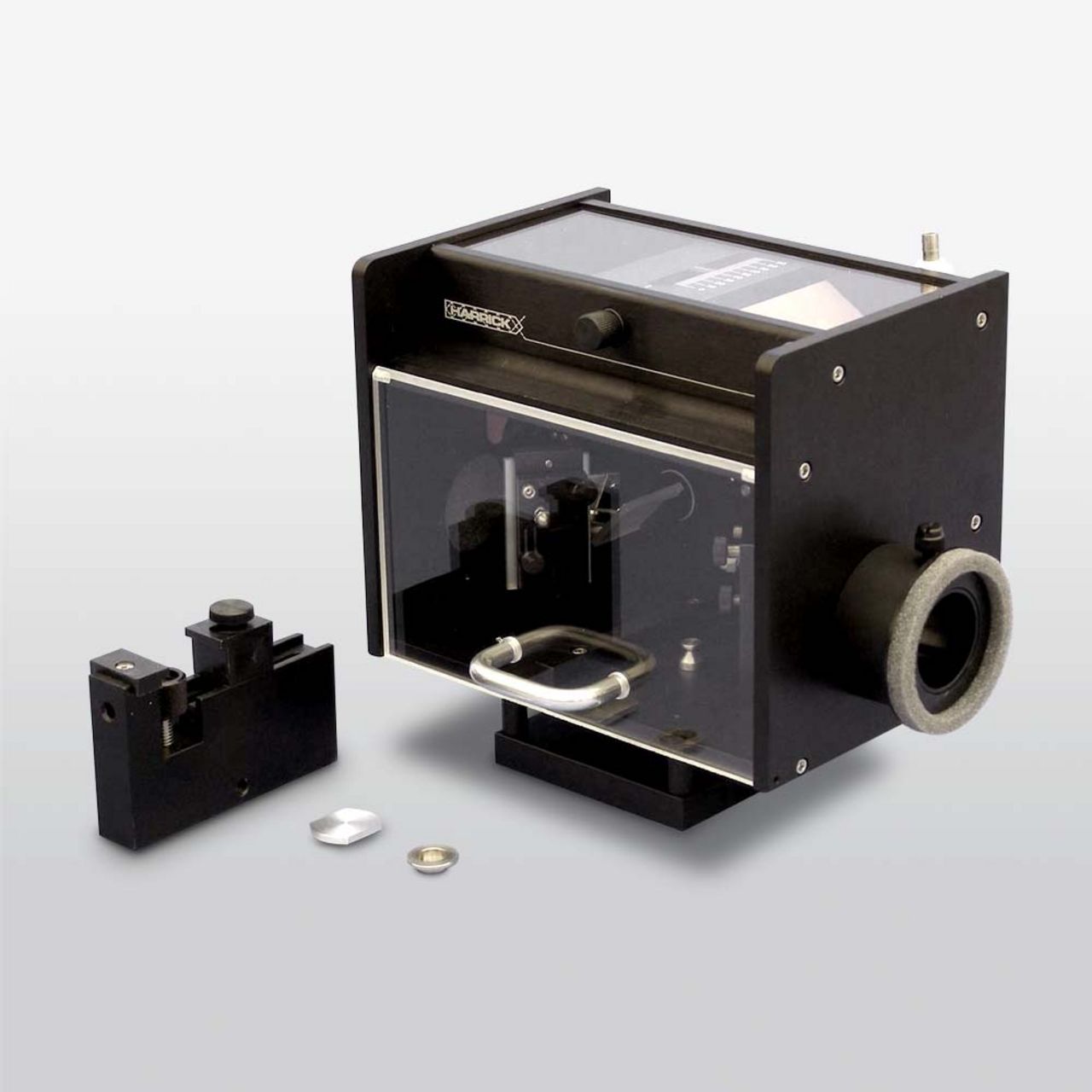
A common measurement requiring polarized light is that of thin films on reflective substrates with infrared reflection absorbance spectroscopy (IRRAS). Molecular dipoles oriented normal to the substrate surface will strongly absorb p-polarized light at grazing (>80˚) angles of incidence [1]. Variable angle specular reflectance accessories such as the Harrick Seagull Variable Angle Reflection Accessory (right) are used to achieve this measurement.
Dichroic measurements of surface immobilized proteins
In reflectance measurements such as attenuated total reflectance and specular reflectance, molecular transition dipoles oriented parallel to the plane of incidence with absorb parallel polarized light more strongly than perpendicularly polarized, and the scaled difference between the two, the dichroic difference spectrum, can be used to measure the relative orientation of the dipoles to the surface [2]
Polarization spectroscopy of gases
Polarization spectroscopy uses polarizers in the crossed configuration described above: a gas placed between the polarizers is excited by a polarized pump laser frequency, which induces detectable polarization changes in a probe beam passing through the sample [3]
Terahertz Time-Domain Spectroscopy
Light sources used for terahertz time-domain spectroscopy are usually linearly polarized: the detectors, too, are sensitive to the polarization [4]. Free standing wire grid polarizers may be used for the region below 0.5 THz [5].
Infrared Ellipsometry
Ellipsometry is a technique that uses a pair of polarizers to measure the change in polarization state of a reflected or transmitted beam after interaction with thin surface layers.
Specac’s Wire Grid Polarizers
Specac manufactures two types of wire grid polarizer covering the entire mid-infrared and far infrared and terahertz regions of the spectrum. Holographic wire grid polarizers for the mid-infrared are directly compatible with their high-end ATR and specular reflectance accessories, while our free-standing wire grid polarizers are suitable for Terahertz spectroscopy.
All Specac Products can be order in Germany with Quantum Design GmbH.
Our product manager Julia Holzmann will be happy to help you find the right product for your application. Feel free to reach out.
References
- T. Elzein et al. FTIR study of polycaprolactone chain organization at interfaces, J. Col. Int. Sci. 273 (2004) 381–387
- J. Shartner et al. Universal Method for Protein Immobilization on Chemically Functionalized Germanium Investigated by ATR-FTIR Difference Spectroscopy, J. Am. Chem. Soc., 2013, 135 (10), pp 4079–4087
- Z. S. Li et al. Detection of methane with mid-infrared polarization spectroscopy, Applied Physics B 79, 135-138 (2004)
- K. Postava et al. Spectroscopy of materials for terahertz photonics, Proc. of SPIE Vol 10142 1014207-1 (2016)
- M. Mičica et al. Analysis of Wire-Grid Polarizers in Terahertz Spectral Range, J. Nanosci. Nanotechnol., 2016, Vol. 18, No. 8
- Specac Ldt., Science and Innovation Centre, Unit 12, Halo Business Park, Cray Ave, Orpington BR5 3FQ, United Kingdom
Contact

Navigation
Categories
Contact
Quantum Design GmbH
Breitwieserweg 9
64319 Pfungstadt
Germany
| Phone: | +49 6157 80710-0 |
| E-mail: | germanyqd-europe.com |
Support