

sCMOS cameras
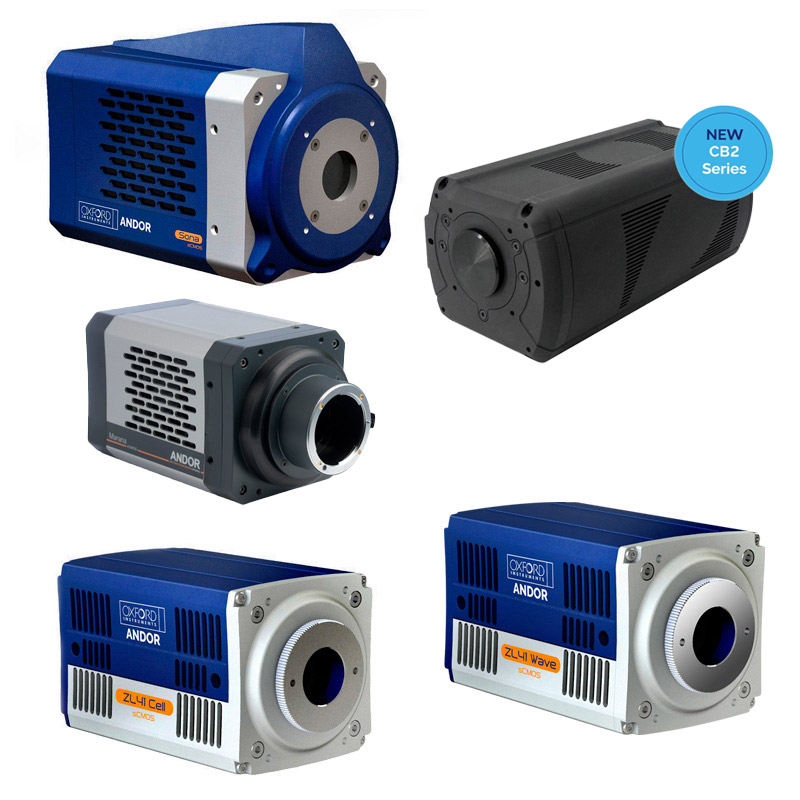
Marana, Sona, CB2 and ZL41 from Oxford Instruments AndorThe Marana, CB2, and ZL41 Wave sCMOS cameras represent a significant advancement of the well-established CMOS technology for scientific applications. Thanks to their unique characteristics, they are well suited for a wide range of quantitative measurement tasks in physics, astronomy, and biology. All Andor sCMOS cameras offer extremely low noise and high sensitivity, enabling them to deliver superior image quality—often even outperforming EMCCD cameras under low-light conditions.
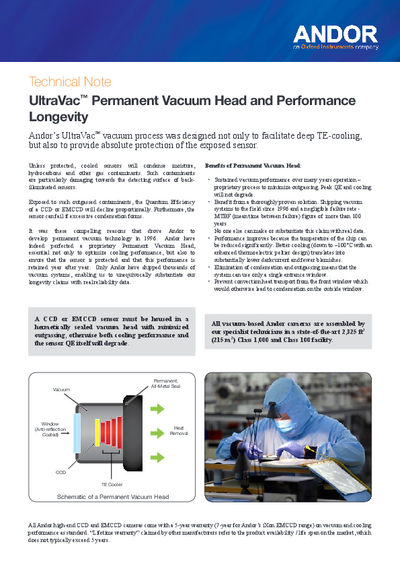
The sensor in the Marana camera is housed in a vacuum enclosure and can be cooled to an industry-leading temperature of -45 °C. This allows its use in the most demanding applications.
In addition to conventional imaging, the Marana and ZL41 Wave sCMOS cameras are also ideal for high-speed spectroscopy, particularly for multi-track and hyperspectral imaging. Among the CB2 models there is the 24.5M which delivers the highest resolution with 24 megapixels, and other high speed sensors offering frame rates up to 941 fps.
- Extremely low read noise of 0.9 electrons (lower detection limit than any CCD camera)
- Quantum efficiency up to 95%
- Resolution 0.5, 1.7, 2.0, 4.2, 5.5, 7.1, 8.1 and 24.5 megapixels
- Pixel sizes between 2.74µm and 11µm
- Rapid frame rates of up to 941 frames/s sustained
- High Dynamic range up to 65,000 : 1
Weitere Informationen
The Marana, Sona and ZL41 sCMOS cameras offer high sensitivity, and high resolution imaging performance – all at once. They can be integrated easily into research applications.
In a vacuum cooled platform, loaded with FPGA intelligence, the Marana and Sona sCMOS cameras are designed to drive highest possible sensitivity from this exciting and innovative technology development. Unlike any CMOS or CCD technology to come before it, Marana, Sona and ZL41 simultaneously deliver highest specifications in sensitivity, resolution, dynamic range and field-of-view: true scientific imaging without compromise.
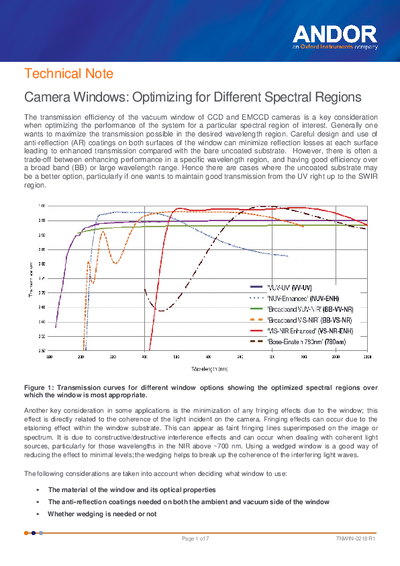
Marana and Sona employ Back Illuminated sCMOS sensors with 4.2 or 2.0 megapixels and highest available quantum efficiency of 95 %.
The ZL41 is ideally suited for many experiments that push the boundaries of speed and sensitivity, offering sustained performance of up to 101 frames per second with CameraLink interface - even faster with sub-images - and read noise down to 0.9 electrons. The ZL41’s unique dark noise suppression technology ensures the low noise advantage is maintained over a wide range of exposure conditions. The 'plug and play' interface option offers industry leading USB 3.0 frame rate performance of up to 53 frames/s at 4.2-megapixel resolution. The unprecedented value and flexibility of the ZL41 means it is also re-defining the concept of a 'workhorse' camera, rapidly displacing interline CCD cameras.
Choice of Rolling and Global (snapshot) exposure mechanisms ensure maximum application flexibility for the ZL41 sCMOS cameras with the 5.5 megapixel sensor; the latter providing a 'freeze frame' capture capability that emulates that of an interline transfer CCD camera.
The CB2 camera series is a high performance scientific camera integrating Sony CMOS sensors specifically designed for research and applications requiring flexibility, speed and low noise. The CB2 series offers a spectral sensitivity from 200 to 1000 nm with resolutions ranging from 0.5 MP to 24.5 MP.
Modelle
| Specification | Marana 4.2 B-11 | Marana 4.2 B-6 | Sona 4.2 B-11 | Sona 2.0 B-11 | Sona 4.2 B-6 Extreme | ZL41 5.5 / 4.2P |
| Resolution | 2048 × 2048 × 11 µm | 2048 × 2048 × 6.5 µm | 2048 × 2048 × 11 µm | 1400 × 1400 × 11 µm | 2048 × 2048 × 6.5 µm | 2560 × 2160 / 2048 × 2048 × 6.5 µm |
| Sensor Diagonal | 31.9 mm | 18.8 mm | 31.9 mm | 21.8 mm | 18.8 mm | 21.8 mm / 18.8 mm |
| Quantum Efficiency | 95 % | 94 % | 95 % | 95 % | 94 % | 64 % / 82 % |
| Read Noise | 1.6 e- | 1.1 e- | 1.6 e- | 1.6 e- | 1.0 e- | 0.9 e- |
| Sensor Temperature | -45 °C | 0 °C or -10 °C | ||||
| Dark Current (e-/pixel/s) | 0.3 | 0.1 | 0.3 | 0.3 | 0.1 | 0.1 / 0.019 |
| Cooling | Air and water | Air and water | Air and water | Air and water | Air and water | Air or water |
| Dynamic Range | 53,000 : 1 | 26,250 : 1 | 53,000 : 1 | 52,000 : 1 | 26,250 : 1 | 33,000 : 1 |
| On-Chip Binning | n/a | n/a | n/a | n/a | n/a | n/a |
| Bit Depth | 16 bit | |||||
| Shutter | Rolling | Rolling and/or Global | ||||
| Interface | USB 3.0 | USB 3.0 / CoaXPress | USB 3.0 | USB 3.0 | USB 3.0 / CoaXPress | USB 3.0 or 10-tap CameraLink |
| Full Frame Rate @ Full Resolution | 48 | 58 / 135 | 48 | 70 | 43 / 135 | 100 |
| Specification | CB2 24.5 MP | CB2 High Speed 7.1 MP | CB2 High Speed 1.7 MP | CB2 High Speed 0.5 MP | CB2 UV 8.1 MP |
| Resolution | 5328 × 4608 × 2.74 µm | 3216 × 2208 × 4.5 µm | 1608 × 1104 × 9 µm | 816 × 624 × 9 µm | 2848 × 2848 × 2.74 µm |
| Sensor Diagonal | 19.3 mm | 17.6 mm | 17.6 mm | 9.2 mm | 11.2 mm |
| Quantum Efficiency | 74 % | 74 % | 74 % | 74 % | >50 % at 300 nm (UV) |
| Read Noise | 1.3 e- | 1.4 e- | 2.6 e- | 2.6 e- | 1.6 e- |
| Sensor Temperature | -20 °C | ||||
| Dark Current (e-/pixel/s) | 0.0015 @ -20 °C | 0.26 @ +20 °C | 1.14 @ +20 °C | 1.54 @ +20 °C | 0.014 @ +20 °C |
| Cooling | Air and water | Air and water | Air and water | Air and water | Air and water |
| Dynamic Range | 29,000 : 1 | 65,000 : 1 | 36,000 : 1 | 36,000 : 1 | 23,000 : 1 |
| On-Chip Binning | 2 × 2 | 2 × 2 | n/a | n/a | 2 × 2 |
| Bit Depth | 12 bit (16 bit HDR) | 14 bit | 14 bit | 14 bit | 16 bit |
| Shutter | Global | ||||
| Interface | CXP-12 or 10 GigE (Eth or optical) | ||||
| Full Frame Rate @ Full Resolution | 74 fps | 134 fps | 481 fps | 941 fps | 127 fps |
Spezifikationen
Anwendungen
Downloads


Videos
Referenzkunden
| Title | Author(s) | Institute | Year | Spectrograph/ Detector |
|---|---|---|---|---|
| Microsopy | ||||
| Microscopy of LEDs and phosphors in practical exercises for students | S. Bock, D. Berben | Department of Electrical Engineering and Information Technology, South Westphalia University of Applied Sciences, Hagen, Germany | 2017 | Neo-5.5-CL3 |
| Fluorescence microscopy of semiconductor nanowire arrays | S. Rahimzadeh-Kalaleh Rodriguez1, D. van Dam2, J. Gomez Rivas1,2 | 1Surface Photonics, AMOLF, c/o Philips Research Laboratories, Eindhoven, The Netherlands 2COBRA Research Institute, Eindhoven University of Technology, The Netherlands | 2014 | Neo DC152 QC-FI1 |
| Detection of electrochemically generated peroxide and superoxide by fluorescence microscopy | C. Dosche, S. Dongmo | Institute of Chemistry, University of Oldenburg, Germany | 2013 | Neo DC152 QC-FI1 |
| Imaging with scintillation screens | ||||
| Phase transitions in 1T-TaS2 mapped by ultrafast LEED | S. Vogelgesang, G. Storeck, S. Schäfer, C. Ropers | IV. Physical Institute, Georg-August-University, Göttingen, Germany | 2017 | Zyla-5.5-CL10 |
| Application of the sCMOS camera Andor Neo for X-ray and neutron imaging | N. Kardjilov1, S. Williams1,2, F. Wieder1, A. Hilger1, I. Manke1 | 1Helmholtz-Zentrum-Berlin, Berlin, Germany 2Johns Hopkins University, Baltimore, USA | 2014 | Neo DC152-QF-FI3 |
| Polarization dependent photoelectron emission with high lateral resolution | T. Wagner | Institute of Experimental Physics, University of Linz, Austria | 2012 | Neo DC152-QC-FI1 |
| Plasma- and fusion research | ||||
| Evaluation of the Zyla sCMOS imaging camera for IMSE diagnostic | O. P. Ford, C. Biedermann | Wendelstein 7-X, Max Planck Institute for Plasma Physics, Greifswald, Germany | 2014 | Zyla-5.5-CL10 |
| Measuring ion temperatures and helium densities in the hot core of a nuclear fusion reactor using sCMOS and EMCCD cameras | R. J. E. Jaspers | Department of Applied Physics, Eindhoven University of Technology, The Netherlands | 2014 | Neo DC152 QC-FI1 |
| Real-time characterization of plasma evolution by diffraction imaging | N. K. Rothe, A. V. Svanidze, C. Schuster, M. Lütgens, S. Lochbrunner | Institute of Physics, University of Rostock, Germany | 2013 | Neo DC152 QC-FI1 |
| Astronomy | ||||
| High-speed imaging and its applications: Beating down the scintillation noise | P. Ioannidis, J.H.M.M. Schmitt | Hamburg Observatory, Physics Department, University of Hamburg, Germany | 2017 | Zyla-4.2-CL10 Neo-5.5-CL3 |
| Active optical debris detection: Highly accurate position determination of space debris orbits | W. Riede, D. Hampf, P. Wagner, L. Humbert, F. Sproll, A. Giesen, | Institute of Technical Physics, Deutsches Zentrum für Luft- und Raumfahrt (DLR), Stuttgart, Germany | 2016 | Zyla-5.5-CL10 |
| Quantum physics | ||||
| Real- and momentum-space imaging of plasmonic waveguide arrays | F. Bleckmann, S. Linden | Physikalisches Institut, Rheinische Friedrich-Wilhelms-Universität Bonn, Germany | 2016 | Zyla-5.5-USB3 |
| Particle image velocimetry (PIV) and particle tracking velocimetry (PTV) | ||||
| Redesign of a 3D PTV system with ANDOR’s Neo sCMOS | P. Steinhoff, M. Schmidt, D. Müller | E.ON Energy Research Center, Institute for Energy Efficient Buildings and Indoor Climate (EBC), RWTH Aachen University, Germany | 2013 | Neo DC152 QFR-FI2 |
| Spectroscopy | ||||
| Photoluminescence spectroscopy of metal nanoantennas coupled to the atomically thin semiconductor WS2 | J. Kern, R. Bratschitsch | Institute of Physics and Center for Nanotechnology, University of Münster, Germany | 2015 | Neo-5.5-CL3 |
| Using a surface-forces-apparatus to measure force-distance profiles across confined ionic liquids | T. Utzig, H.-W. Cheng, M. Valtiner | Department of Interface Chemistry and Surface Engineering, Max-Planck-Institut für Eisenforschung, Düsseldorf, Germany | 2014 | Zyla-5.5-CL3 |
Remarks:
1New part number of DC152 QC-FI: Neo-5.5-CL3
2Neo DC152 QFR-FI replaced by Neo-5.5-CL3-F
3New part number of DC152 QF-Fi: Neo-5.5-CL3-F
Kontakt

Navigation
Kategorien
Kontakt
Quantum Design SA
Rue du Nord3
CH-1400 Yverdon-les-Bains
Switzerland
| Telefon: | +41 21 8699-033 |
| E-Mail: | suisseqd-europe.com |